
Can You Train Every Day? Dr. Charlotte Weidenbach Explains What Actually Works
If you’ve ever finished a great workout and thought, Maybe I should train every day, you’re in good company. It’s one of the most common questions in fitness, and the answer is more interesting than most people expect. Recently, Peloton instructor and licensed physician Dr. Charlotte Weidenbach addressed it directly on Instagram, and her response cuts right through the noise with the kind of clarity that only a medical mind brings to the conversation.
Who Is Dr. Charlotte Weidenbach?
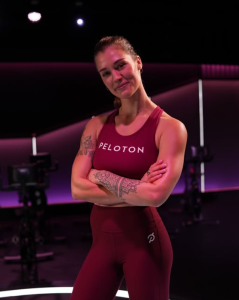
Charlotte Weidenbach studied human medicine at Charité Berlin, one of Europe’s most prestigious medical universities, and it was during those years that she became convinced that the most powerful medicine is the kind that comes before illness ever takes hold. After earning her medical degree in 2021, she joined Peloton as a cycling instructor. She now lives and works in London as a Peloton instructor and speaker, translating medical knowledge into movement and everyday life, with a focus on making health practical and applicable rather than theoretical.
Charlotte is a fully-trained, deeply-informed physician, and that perspective shapes everything she does on the Peloton platform. Her programming isn’t random, her recovery cues aren’t filler, and her low-impact rides aren’t just “easy days” to round out a schedule. There’s intention behind it all. She approaches fitness through a prevention lens, not just performance or treatment, but longevity and sustainability.
Off the bike, her medical degree and her background in physiology and preventive medicine directly shapes how she teaches, both in class and on social media. Her Fact Friday and Myth Monday segments have addressed fitness and nutrition misconceptions using an evidence-based approach, and she and fellow Peloton instructor Mayla Wedekind launched an Instagram series called Psychology Meets Medicine. More recently, she has been fielding member questions through an ongoing Instagram Q&A series covering everything from muscle building to training frequency.
So, Can You Train Every Day?
In her Instagram post, Charlotte answers the question head-on: yes, many people can train every day, but not necessarily in the way most people think.
Her first point reframes the entire conversation. Your body, she explains, does not recover in neat 24-hour blocks where everything is either fully recovered or not at all. Recovery happens both locally and systemically, and it is highly dependent on your training experience, your volume, your intensity, but also your sleep, your nutrition, and your stress levels.
That last part matters more than most fitness content acknowledges. Two people doing the exact same workout can be in completely different recovery states depending on how well they slept, what they ate, and how much life stress they are carrying. A physician understands this in a way a generic training app simply cannot.
The Real Question to Ask
Charlotte says the important question is not how many days per week to train. Instead, it is: can your body actually recover from what you are asking it to do?
This is a meaningful shift away from counting workout days on a calendar. Charlotte asks you to look at the type of stress you are creating and whether your body has the capacity to absorb it. And she is specific about the differences: an intense lower-body strength session creates a very different recovery demand than a low-intensity cardio session. A high-intensity upper-body session is different from mobility work. High-intensity cardio is different from a recovery ride. Treating all of these as equivalent just because they each fill a one-hour block on your schedule is, from a physiological standpoint, a mistake.
More Training Is Not Automatically Better
This is the core of Charlotte’s message, and it is worth reading twice: more recoverable training is better than simply more training.
Adaptation, she explains, only happens when your body can actually keep up with the stress you are creating. If you are consistently outpacing your body’s ability to recover, you are not accumulating fitness. You are accumulating fatigue. Sometimes, training at a lower intensity allows for better recovery and therefore produces better long-term adaptations. As Charlotte puts it directly: that is not lazy. That is smart programming.
Charlotte’s broader philosophy reflects this precisely: adaptation happens through the balance between stress and recovery, not through constant strain. Recovery is an active part of health, not a pause from it. Physical activity and movement are the foundation, and training adds structure and intent. Both matter, and they should not be confused.
The Patience Factor
There is one more piece of Charlotte’s post that deserves its own spotlight, because it is the part the fitness industry rarely wants to say out loud.
Progress comes fastest at the beginning. When someone new to training starts seeing rapid changes in strength, endurance, or body composition, it can feel like pushing harder and more often will keep that momentum going. It rarely does. Charlotte is candid about this: early progress moves quickly, but what matters far more than one or two weeks of extreme high-intensity training is consistent training over months and years, even at a lower intensity, advancing and changing the program over time. That is what creates real adaptations.
This is not a message designed to go viral. It does not promise a 30-day transformation. But it is exactly the kind of evidence-based, long-view thinking you get when your fitness instructor is also a doctor.
What This Looks Like in Practice
Applying Charlotte’s framework to a weekly training schedule means asking a few honest questions before you plan your sessions. How hard was yesterday’s workout, and what muscle groups did it stress? How did you sleep? What does the rest of your day look like? Is this a week when your life stress is high?
From there, the goal is not to fill every day with hard effort. It is to structure your week so that intense sessions are bookended by genuinely easier days, whether that is a recovery ride, a stretch class, a walk, or a full rest day. As Charlotte says on the Peloton platform: every time you work out, you are doing something good for yourself. But that also means respecting what your body needs in order to actually benefit from the work.
The version of “training every day” that Charlotte endorses is intentional, varied, and recovery-aware. It is built for someone who wants to still be training years from now, not just grinding through a streak on an app.
The Bottom Line
Can you train every day? According to Dr. Charlotte Weidenbach, yes, but the question itself may be the wrong one to start with. Ask instead whether your body can recover from what you are asking it to do. Build your training around that answer, be patient with the process, and prioritize consistency over intensity. That approach, rooted in physiology and preventive medicine, is what creates real, lasting change.
It is also, not coincidentally, exactly the kind of advice you get when your instructor went to medical school before she got on the bike.
Haven’t tried a class with Dr Charlotte yet? Check out our hidden gems article.
The Clip Out is an independent Peloton news site with reporting, analysis, and community insights. We deliver breaking updates, feature reporting, and expert context on the stories driving the community and the industry.
Our weekly podcast offers deeper conversation and perspective, and you can find us on Apple Podcasts, Spotify, iHeart, TuneIn, and YouTube Music. You can also follow us on our socials on Facebook, Threads, Instagram, BlueSky, and YouTube.
See something in the Peloton universe that you think we should know? Visit us at theclipout.com and submit a tip.
About the Author: Liz Nikol (#JustAskForHelp)

Latest Podcast

Subscribe
Keep up with all the Peloton news!