

Peloton Q4 FY2026 Earnings Reveal First Profitable Year
Full year profit hit a milestone even as revenue slipped, guidance missed on EBITDA, and Peloton outlined its next moves in Pilates, strength, and commercial fitness.

Peloton Q4 FY2026 earnings closed out the company’s strongest fiscal year on record, with the company reporting positive net income and positive operating income for a full year for the first time since it was founded. The results, released August 6, 2026, show a business that has moved from turnaround story to sustained Peloton profitability, even as full year revenue slipped slightly and one key profit metric landed just under guidance.
Peloton Q4 FY2026 Earnings by the Numbers
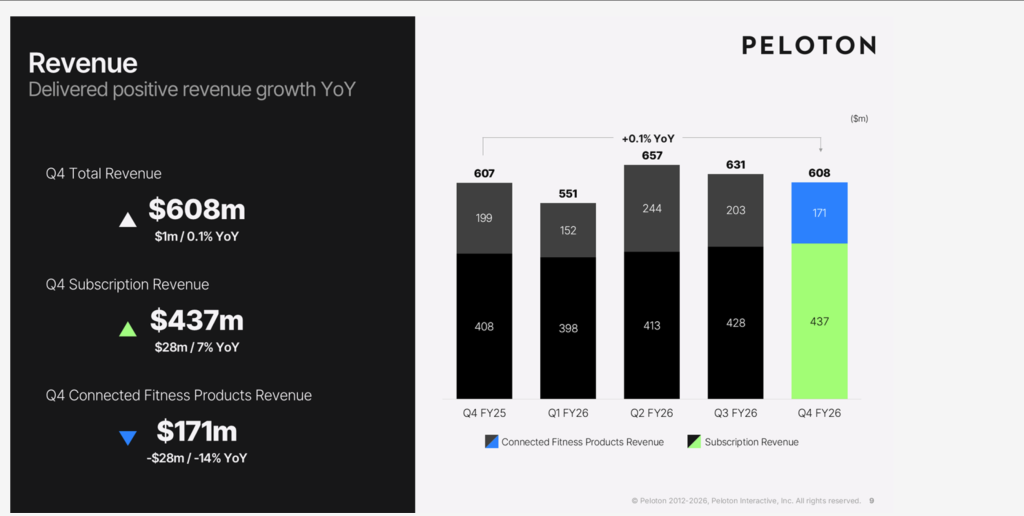
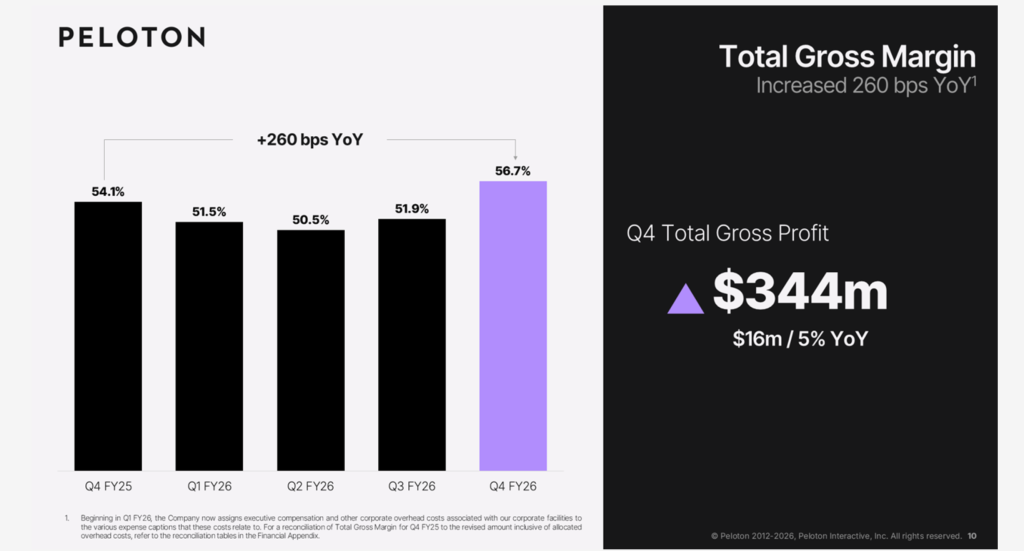
The Peloton Q4 FY2026 earnings report shows total revenue for the fourth quarter reached $608 million, up $1 million year-over-year. Subscription revenue grew 7% to $437 million, while Connected Fitness Products revenue fell 14% to $171 million. Total gross margin came in at 56.7% for the quarter, up 260 basis points year-over-year, with total gross profit reaching $344 million, a 5% increase.
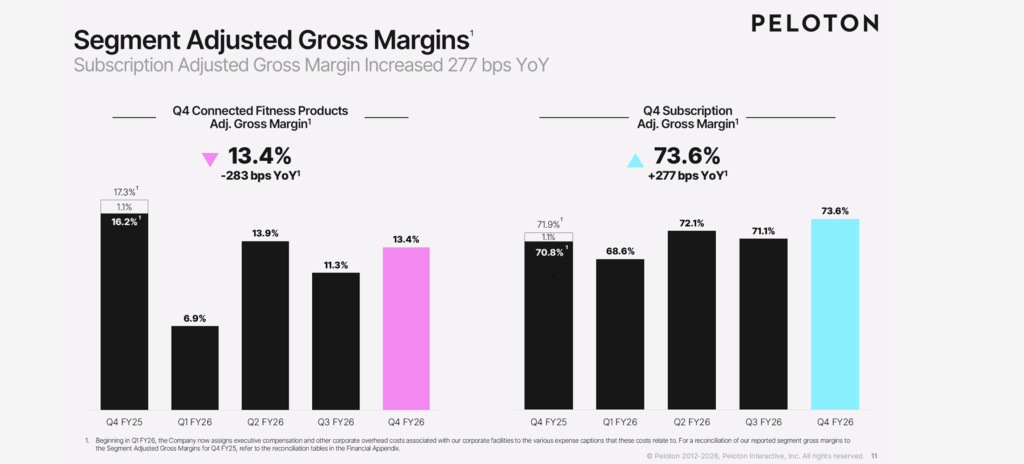
Segment margins moved in opposite directions in this round of Peloton Q4 FY2026 earnings. Subscription Adjusted Gross Margin climbed to 73.6%, up 277 basis points year-over-year, while Connected Fitness Products Adjusted Gross Margin fell to 13.4%, down 283 basis points. Q4 Adjusted EBITDA reached $142 million, up 2% year-over-year, though that figure includes a $23.8 million nonrecurring accrued legal contingency tied to patent litigation. Q4 free cash flow was $89 million, down 21% year-over-year.
Full Year FY26 Results Against Guidance
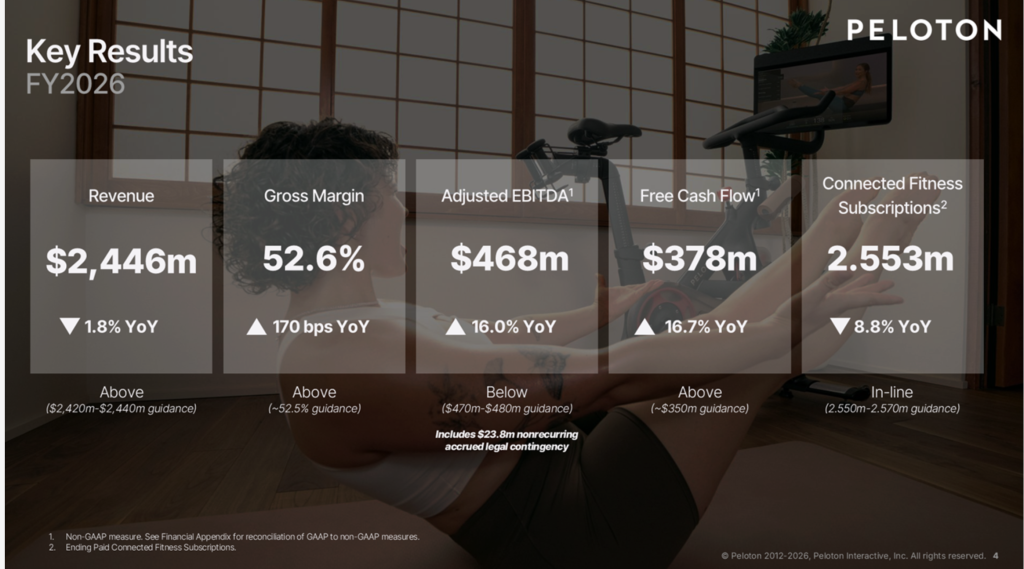
For the full fiscal year, Peloton Q4 FY2026 earnings show total revenue of $2.446 billion, down 1.8% year-over-year but $6 million above the company’s own guidance range. Total gross margin reached 52.6% for the year, up 170 basis points year-over-year and above the roughly 52.5% guidance midpoint.
Looking ahead to fiscal 2027, guidance calls for total revenue of $2.3 billion to $2.4 billion, down 3.9% year-over-year at the midpoint, total gross margin around 54%, and Adjusted EBITDA of $475 million to $525 million, up 6.8% at the midpoint. Free cash flow guidance holds at a minimum of $350 million. Together, the numbers laid out alongside Peloton Q4 FY2026 earnings point toward continued Peloton profitability even as the top line contracts. Peloton attributed the projected revenue decline to a mechanical effect rather than a demand problem, noting that fiscal 2027 will lap the price increases it implemented on hardware and subscriptions last fall, making prior-year comparisons artificially high.
Adjusted EBITDA for the full year came in at $468 million, up 16% year-over-year but below the $470 million to $480 million guidance range, a gap the company attributed to the one-time legal contingency recorded in the fourth quarter. Free cash flow reached $378 million, up 16.7% and above the roughly $350 million guidance target. Ending paid Connected Fitness Subscriptions closed at 2.553 million, down 8.8% year-over-year and in line with guidance. Against that backdrop, Peloton Q4 FY2026 earnings still represent the strongest full-year financial picture in company history.
A Full Year of Peloton Profitability
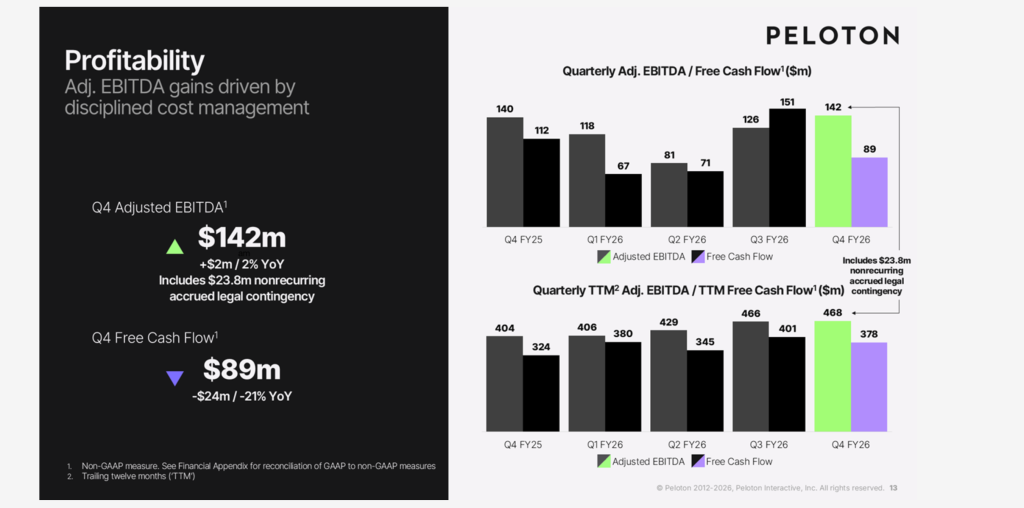
The headline of this Peloton Q4 FY2026 earnings report is not a single quarter’s numbers. It is the full-year picture. Peloton achieved positive net income and positive operating income across all of fiscal 2026, a milestone the company has not reached in a complete fiscal year since it went public. The turnaround is stark in dollar terms: full-year net income reached approximately $63 million in fiscal 2026, compared to a net loss of $118.9 million the year before. That shift follows several quarters of steady progress toward Peloton profitability, including the trailing-twelve-month profit milestone the company reported back in its Q3 FY2026 results.
“This was the year where Peloton sort of grew up,” CEO Peter Stern told CNBC, calling fiscal 2026 a “landmark” year for the company financially. He added that the results position the company for long-term growth toward what it describes as becoming a connected wellness company, calling it Peloton’s strongest position to date.
Cost discipline played as large a role in that outcome as revenue growth. Peloton confirmed it exceeded its target of delivering more than $100 million in run-rate cost savings by the end of fiscal 2026. Q4 adjusted operating expenses fell to $257 million, down 2% year-over-year, while stock-based compensation expense dropped to $43 million, down 19% year-over-year and now representing just 7% of total revenue. That cost discipline is a large part of why Peloton Q4 FY2026 earnings mark a turning point rather than a one-quarter outlier.
Balance Sheet and Cost Discipline
Peloton’s balance sheet showed meaningful deleveraging in fiscal 2026. Net debt fell to $93 million, an 80% decrease year-over-year, while the gross leverage ratio dropped to 2.8x and net leverage fell to 0.3x, both improvements of a full turn year-over-year. That progress, laid out alongside the rest of the Peloton Q4 FY2026 earnings materials, supports continued Peloton profitability heading into fiscal 2027 and gives the company more room for strategic capital allocation going forward.
Q1 and Full Year FY27 Guidance
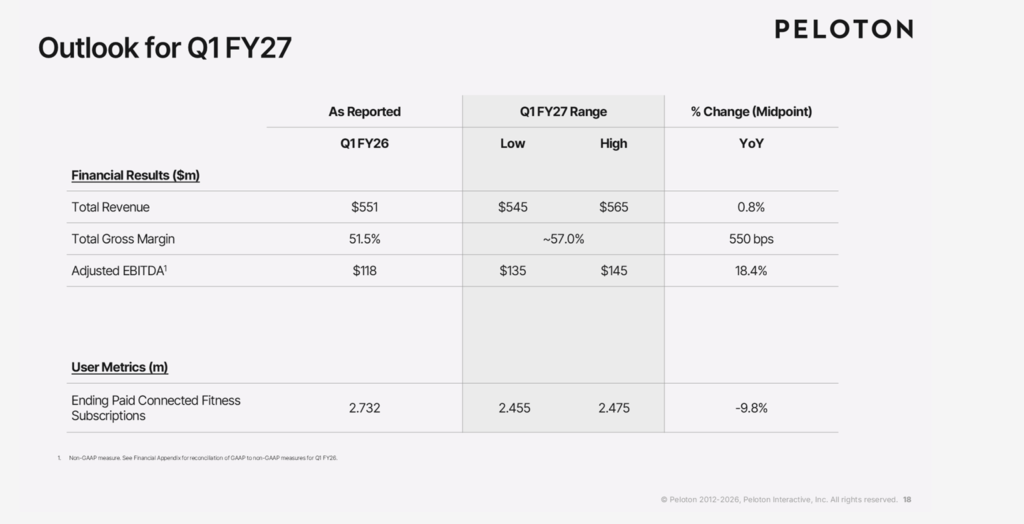
Looking ahead, Peloton’s guidance for the first quarter of fiscal 2027 includes total revenue of $545 million to $565 million, roughly flat year-over-year at the midpoint, alongside total gross margin of approximately 57%, up 550 basis points year-over-year. Adjusted EBITDA is guided to $135 million to $145 million, up 18.4% year-over-year at the midpoint, while ending paid Connected Fitness Subscriptions are expected between 2.455 million and 2.475 million, down 9.8% year-over-year.
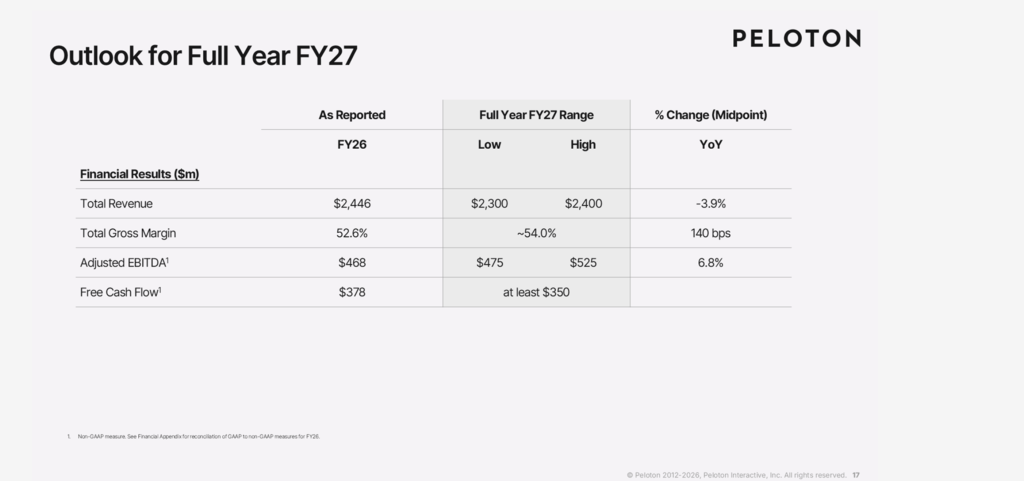
For the full fiscal year, guidance calls for total revenue of $2.3 billion to $2.4 billion, down 3.9% year-over-year at the midpoint, total gross margin around 54%, and Adjusted EBITDA of $475 million to $525 million, up 6.8% at the midpoint. Free cash flow guidance holds at a minimum of $350 million. Together, the numbers laid out alongside Peloton Q4 FY2026 earnings point toward continued Peloton profitability even as the top line contracts.
Commercial Growth, Skōp, and Spotify
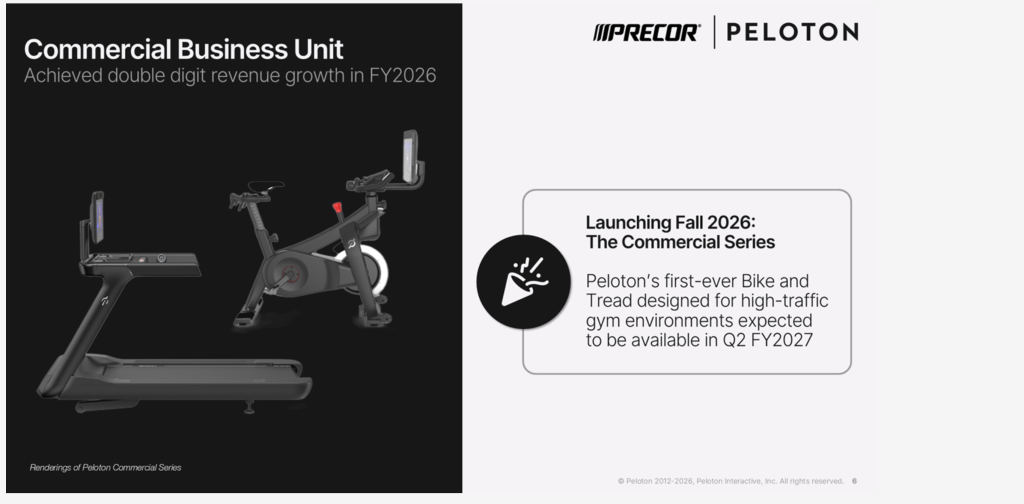
Peloton’s Commercial Business Unit, which includes its Precor commercial fitness division, achieved double-digit revenue growth in fiscal 2026, though the segment still represents only about 4% of the broader commercial fitness equipment market. The company also reminded us that the Commercial Series, its first-ever Bike and Tread built specifically for high-traffic gym environments, is set to launch by the end of this calendar year with broader availability expected in the second quarter of fiscal 2027. Executives described the launch as one that will accelerate growth in a dual-brand strategy alongside Precor, with the commercial push expected to precede a corresponding increase in subscriptions rather than follow it.
The company expanded its global digital reach through its content licensing partnership with Spotify, which puts Peloton classes in front of Spotify Premium subscribers worldwide without requiring them to own Peloton hardware. Peloton said the Spotify partnership is helping build brand awareness and test demand in markets outside its core equipment base, and noted that Mexico recently became its most engaged market outside the United States.
On the acquisition front, Peloton completed its purchase of Skōp, an early innovator in Connected Pilates technology. “Pilates is a category ripe for the same kind of experiential reinvention we brought to cardio,” said Peloton CEO Peter Stern, describing the deal as an investment meant to build on the company’s leadership in at-home Pilates and push further into strength.

Peloton also acquired Breathwrk, an award-winning app specializing in breathing exercises, and has since expanded it to include meditation content, adding another wellness category to its ecosystem and another building block behind this year’s Peloton profitability.
Product and Content Expansion
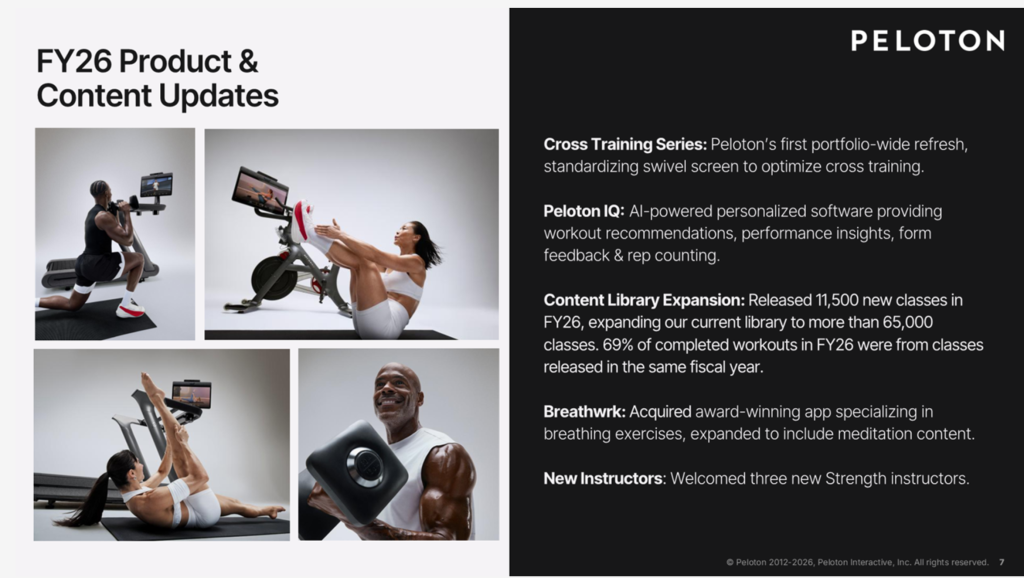
On the product side, Peloton rolled out its Cross Training Series in fiscal 2026, the company’s first portfolio-wide hardware refresh, standardizing a swivel screen across devices to better support cross training. More than half of members have already interacted with the platform’s guidance features tied to that refresh. The company also introduced Peloton IQ, AI-powered software that delivers personalized workout recommendations, performance insights, form feedback, and rep counting. Both updates were highlighted as part of the broader Peloton Q4 FY2026 earnings narrative around product investment.
Content output grew substantially as well. Peloton released 11,500 new classes in fiscal 2026, expanding its total library to more than 65,000 classes. Notably, 69% of completed workouts during the year came from classes released in that same fiscal year, a sign that fresh content continues to drive the bulk of member engagement. The company also welcomed three new Strength instructors during the year.
New Categories, Wearable Partnerships, and Retail Growth
Peloton also used the call to tease a new product category. The company said it plans to announce an entirely new category in fall 2027, with additional launches to follow, a roadmap it expects will open new addressable markets and accelerate growth beyond what the Commercial Series alone will deliver. We presume that if it launches in the fall, and it follows the launch of the Cross Training series in October of 2025, we’ll see shipments begin before the 2026 holiday season. Executives were not ready to share specifics but confirmed that revenue growth from these new categories is expected to precede any corresponding increase in subscriptions.
On wearables, Peloton described its approach as staying neutral rather than building its own device, aiming to integrate with as many wearable platforms as possible. The company said it has partnerships with major wearable makers, including Apple, Google, and Garmin, and that it expects to announce at least two more “major” partnerships soon. The partnerships range from ingesting member data with permission to providing data back to those platforms and co-marketing. Peloton framed this as one of the clearest paths to serving members across every wearable they already own while continuing to grow subscribers.
Retail also got a mention as part of the Peloton Q4 FY2026 earnings business highlights. The company’s microstore format has now reached 10 locations and is outselling Peloton’s legacy showrooms. Peloton announced three additional microstores today, and 7 more planned before the holiday season, continuing an expansion strategy built around a lower-cost, higher-converting retail footprint.
Peloton also pointed to Peloton IQ as a growing priority. The company said AI-driven features rank as the top interest among prospective new members researching the platform, and it plans to expand Peloton IQ toward more open-ended goal setting, more dynamic program adjustments based on real-time member data, and deeper integration with the wearable partnerships described above.
Programs Drive Member Engagement
Peloton pointed to strong member engagement with its newer training programs as part of the Peloton Q4 FY2026 earnings business highlights. The Pace Your Race Marathon Training Program and the Live Spring Cross-Training Plan together drove more than 850,000 completed workouts in the fourth quarter alone, a sign that structured, multi-modality programming continues to resonate with members across Tread, Strength, and outdoor content. Pilates engagement was up 54% year-over-year, and the HiLIT+ program has already drawn 200,000 members across 1.2 million completed classes.
Taken together, the Peloton Q4 FY2026 earnings results describe a company that has converted several years of restructuring into a full fiscal year of profitability, even as it navigates a shrinking subscriber base and a revenue outlook that points downward before it points back up. The commercial business, content licensing strategy, expanding product portfolio, wearable partnerships, and program lineup all contribute revenue that does not depend solely on new hardware sales, which is the case Peloton is making for why this year’s Peloton profitability is durable rather than a one-time peak.
Full financial results, the fiscal 2027 guidance, and the complete earnings presentation behind this Peloton Q4 FY2026 earnings report are available on Peloton’s Investor Relations site.
The Clip Out is an independent Peloton news site with reporting, analysis, and community insights. We deliver breaking updates, feature reporting, and expert context on the stories driving the community and the industry.
Our weekly podcast offers deeper conversation and perspective, and you can find us on Apple Podcasts, Spotify, iHeart, TuneIn, and YouTube Music. You can also follow us on our socials on Facebook, Threads, Instagram, BlueSky, and YouTube.
See something in the Peloton universe that you think we should know? Visit us at theclipout.com and submit a tip.
About the Author: Jen Kern

Latest Podcast


Subscribe
Keep up with all the Peloton news!