
Peloton Enterprise AI Leader Warns AI Pilots Often Fail
Peloton Enterprise AI Leader Spoke on AI Risk at Chicago Forum
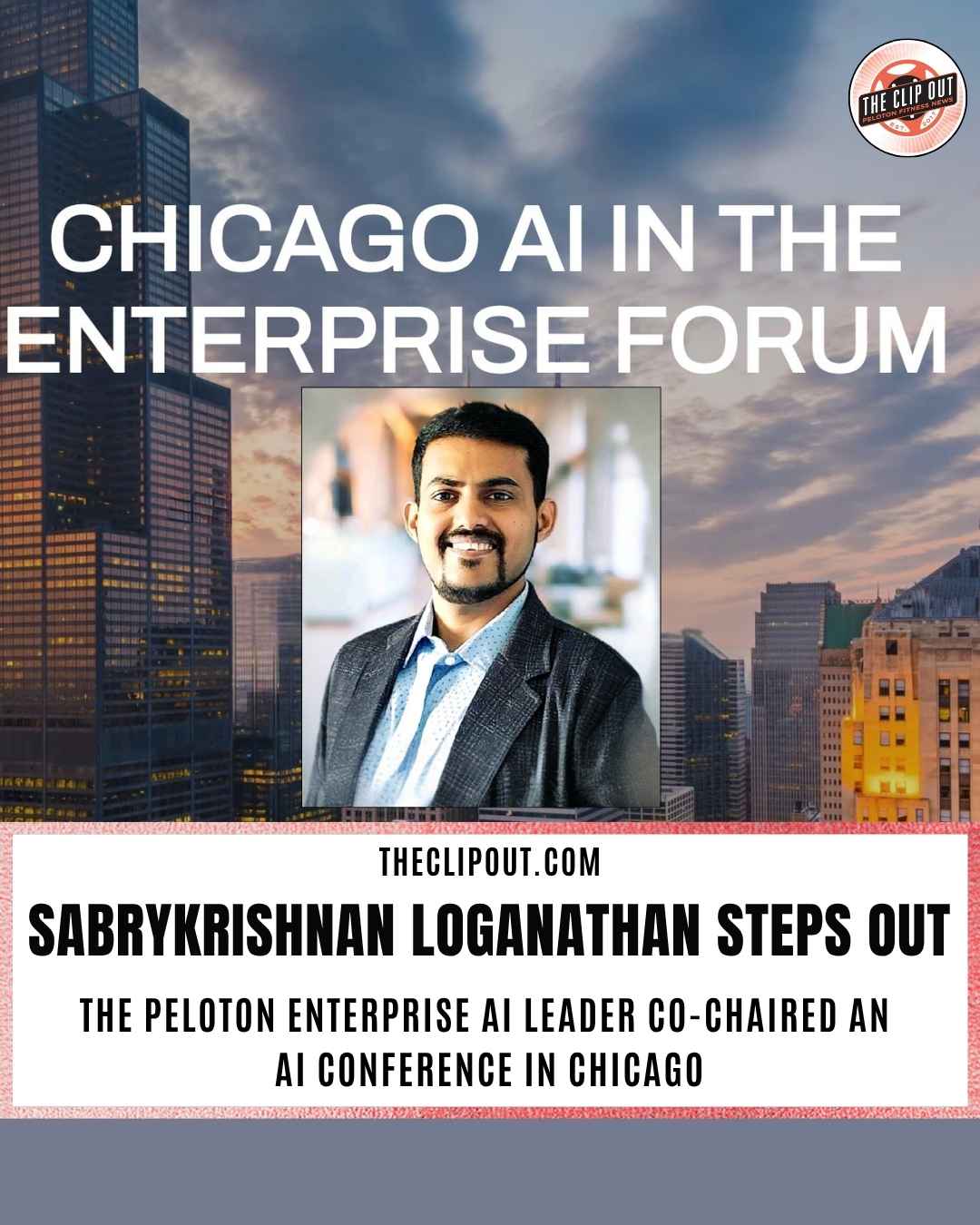
Sabrykrishnan Loganathan joined a panel on closing the gap between AI pilots and AI in production at the Chicago AI in the Enterprise Forum.
Peloton’s enterprise AI leadership headed to Chicago last week. Sabrykrishnan Loganathan, Senior Director and Head of Enterprise AI at Peloton, appeared as a panelist at the Chicago AI in the Enterprise Forum on Monday, June 22, joining a discussion focused on what separates organizations that talk about AI from organizations that actually run it in production.
Enterprise AI refers to artificial intelligence systems built and deployed for use inside a company’s own operations, rather than AI built for consumers. Instead of a chatbot or recommendation feature a customer might interact with directly, enterprise AI tools are designed to support internal workflows: things like data analysis, security monitoring, customer service operations, or decision-making processes that employees rely on day to day. The discipline has become a major focus across industries in 2026, as more companies move from testing AI tools to actually running them at scale, which is the exact tension the Chicago panel was built to address.
The panel, titled “AI-Eager vs. AI-Ready: The Foundational Work That Separates Pilots from Production,” ran from 1:10 PM to 1:55 PM CDT. It was moderated by Julia Napolitano, Vice President of Solution Engineering for the MuleSoft and Informatica practice at Salesforce. Loganathan was joined on the panel by Suma Nair, a data and analytics leader in consumer community banking at JPMorgan Chase, and Grant Ecker, Vice President of Enterprise Architecture at Ecolab.
According to the session description, the conversation was built around a gap many companies are running into right now: plenty of organizations have an AI use case, but far fewer have one that actually works at scale. The panel was framed as a practitioner-level discussion rather than a sales pitch or roadmap presentation, with each panelist speaking from inside their own enterprise AI work.
What the Panel Covered
The session description outlined several specific areas the panelists intended to address. One was the idea that most enterprise AI requests start as business problems that get treated like technology problems, with organizations rushing toward a tool before they have actually defined what they are solving. Another was a more current definition of what makes data “AI-ready” in 2026, moving past basic data quality questions into context, lineage, and the kind of trust signals that let AI agents act with precision rather than guesswork.
A third focus area was access and security risk tied to agentic AI, the type of AI system that takes action on a user’s behalf rather than simply generating a response. According to the panel description, when an agent acts for a user, it inherits that user’s credentials, along with any existing gaps in that user’s access controls. At the scale of a regulated industry, the panel description framed that as a problem already inside the enterprise, not a future one. For a company like Peloton, enterprise AI questions like these carry real weight as Peloton enterprise AI systems take on more internal decision-making.

Loganathan’s Peloton Enterprise AI Role at the Forum
Loganathan also served as a co-chair of the broader Chicago AI in the Enterprise Forum, alongside Patrick Chew, Vice President of AI and Data Science at AIT Worldwide Logistics, and Ivana Donevska, U.S. Data, Analytics and AI Risk Head at BMO. The event took place at the Westin Chicago River North and was structured as an invitation-only, single-stage forum built around five discussion tracks, including data and AI strategy, AI ethics and governance, and leadership and organizational transformation tied to AI adoption.
Peloton enterprise AI leadership has been building out its technical bench over the past few years, including the creation of its first Chief Technology Officer role, and Loganathan himself only being at Peloton since February 2025 and in this role since January 2026. The company has also been the subject of reporting on how AI is reshaping its internal operations. Loganathan’s appearance on a panel, built specifically around enterprise AI governance and readiness adds another data point to how seriously Peloton’s technical leadership engages with the broader AI industry conversation, beyond the platform’s member-facing features.
The Clip Out is an independent Peloton news site with reporting, analysis, and community insights. We deliver breaking updates, feature reporting, and expert context on the stories driving the community and the industry.
Our weekly podcast offers deeper conversation and perspective, and you can find us on Apple Podcasts, Spotify, iHeart, TuneIn, and YouTube Music. You can also follow us on our socials on Facebook, Threads, Instagram, BlueSky, and YouTube.
See something in the Peloton universe that you think we should know? Visit us at theclipout.com and submit a tip.
About the Author: Elizabeth Schlosberg

Latest Podcast

Subscribe
Keep up with all the Peloton news!