
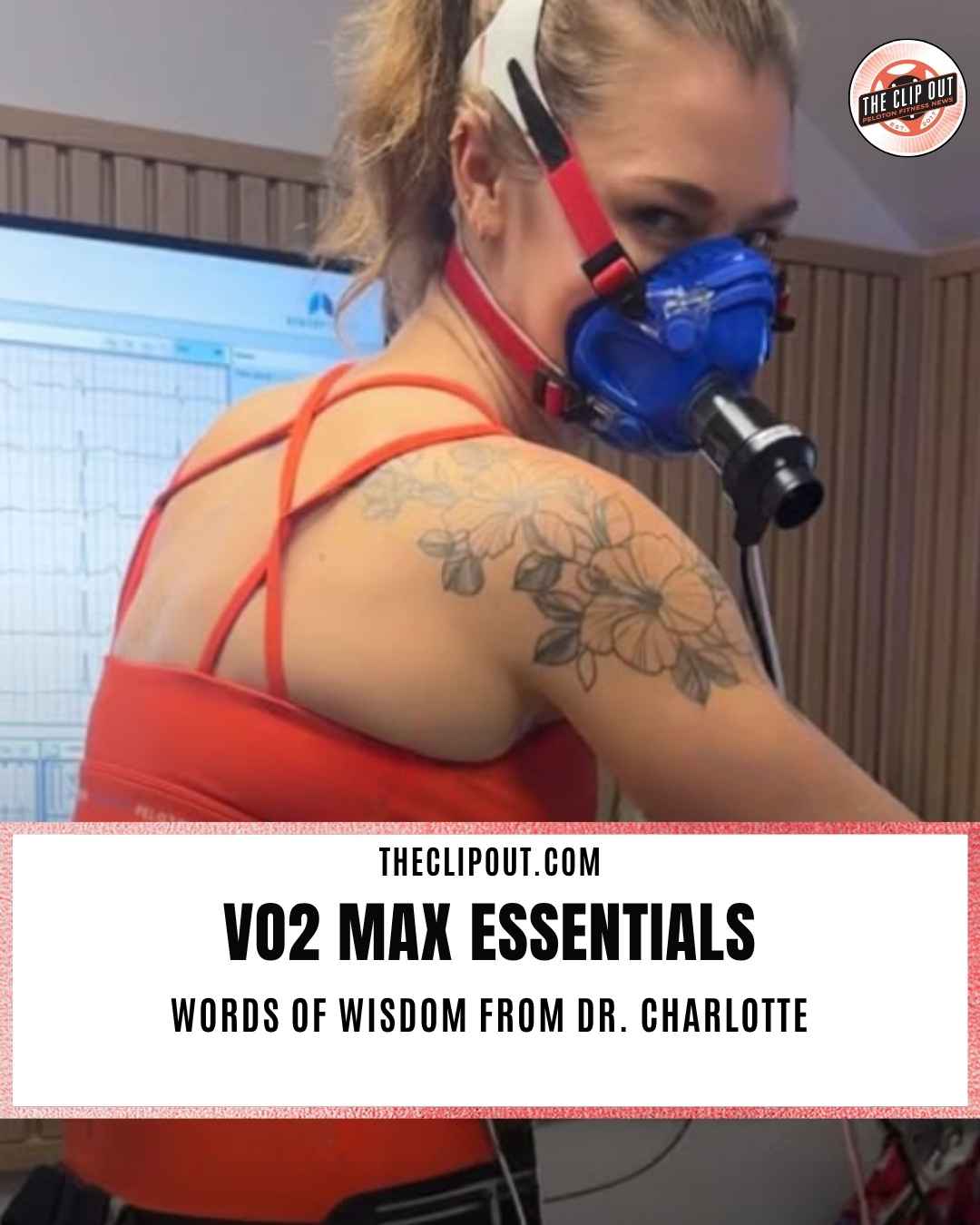
VO2 Max Essentials: What Peloton’s Dr. Charlotte Says
Peloton instructor Dr. Charlotte Weidenbach tests her VO2 Max every year. Not because she considers it the single most important number in health, but because she finds it useful for tracking how her body adapts over time. In a recent Instagram post, the German physician and Power Zone instructor broke down what VO2 Max actually measures and why it earns a place in a long-term fitness plan.
What Is VO2 Max?
VO2 Max is the maximum rate at which the body can take up, transport, and use oxygen during maximal effort. The number reflects a full chain of systems working together: air moving into the lungs, the heart pumping blood, blood vessels delivering it, muscles receiving it, and mitochondria converting it into usable energy. Because so many systems are involved, VO2 Max represents the body’s overall oxygen transport capacity, not the output of one organ.
Why VO2 Max Predicts Long-Term Health
Higher cardiorespiratory fitness is tied to lower cardiovascular disease risk, lower all-cause mortality, and greater physiological reserve. A widely cited 2018 JAMA Network Open study of more than 122,000 adults found cardiorespiratory fitness to be one of the strongest predictors of survival researchers have measured, with no upper limit to the benefit. Dr. Charlotte was careful to note that a high VO2 Max score does not protect the body by itself. It reflects the combined result of multiple physiological adaptations that add up to a more resilient body, one better equipped to handle aging, illness, and recovery.
Physiological Reserve: The Buffer That Protects You
One of the more useful concepts Dr. Charlotte highlighted is physiological reserve, the buffer between the demands of everyday life and a person’s physical limit. Climbing a flight of stairs takes low effort for a trained 40 year old. That same task takes moderate effort for a trained 80 year old, and high effort for an untrained 80 year old. The stairs never change. What changes is the size of the buffer between daily demand and physical capacity, and training is what preserves it.
Different Training Methods, Different Adaptations
No single workout style builds every component of fitness, which is part of why Peloton’s class formats span so many disciplines. Zone 2 training builds mitochondrial density, capillary density, and oxidative capacity. High intensity training builds stroke volume and maximal cardiac output. Strength training builds neuromuscular function, muscle strength, and movement economy. Each style contributes a different piece of the fitness picture, and combining them produces adaptations no single method delivers alone.
Dr Charlotte’s broader point is that VO2 Max is one of the strongest predictors of long-term health available, but it is not the whole picture. It measures cardiorespiratory capacity, responds well to training, and correlates strongly with health outcomes, yet it does not capture strength, mobility, or mental health. Understanding what a metric shows, and what it leaves out, matters more than chasing a single number.

Who Is Dr. Charlotte Weidenbach?
Dr. Charlotte joined Peloton as a cycling instructor in 2021 after training as a physician at Charité Berlin, one of Europe’s leading medical schools. She teaches from London in both English and German and has built a following through her Power Zone classes as well as her metal and hard rock themed rides. Her medical background shapes how she programs: recovery cues, pacing, and structure are built around physiology and prevention, not performance alone. Members who know her primarily for her high-energy metal rides often find her science-based approach to training, including her interest in metrics like VO2 Max, is just as central to who she is as an instructor.
For members deciding what to track, Dr. Charlotte’s approach offers a useful model: treat a number like VO2 Max as a window into how the body is adapting, not as a verdict on overall health.
Craving more advice from Dr. Charlotte? The Clip Out has covered Dr. Charlotte’s health and fitness expertise a few times in the last year. In February, we spotlighted her science-driven approach to programming in our Peloton Hidden Gems feature, and in May, we broke down her Instagram Q&A on muscle building, where she answered followers’ most common training questions. Earlier this month, we reported on her appearance alongside a cardiologist at a panel on evidence-based health and the future of fitness, where she spoke about connecting medical science with everyday coaching. Follow her on Instagram and you are sure to get more valuable tidbits.
The Clip Out is an independent Peloton news site with reporting, analysis, and community insights. We deliver breaking updates, feature reporting, and expert context on the stories driving the community and the industry.
Our weekly podcast offers deeper conversation and perspective, and you can find us on Apple Podcasts, Spotify, iHeart, TuneIn, and YouTube Music. You can also follow us on our socials on Facebook, Threads, Instagram, BlueSky, and YouTube.
See something in the Peloton universe that you think we should know? Visit us at theclipout.com and submit a tip.
About the Author: Liz Nikol (#JustAskForHelp)

Latest Podcast


Subscribe
Keep up with all the Peloton news!