
How Peloton Software Features Build Loyalty
Peloton’s Q3 FY2026 earnings deck named three software features as its core strategy for reversing subscriber decline, and quietly introduced an AI feature with global reach.
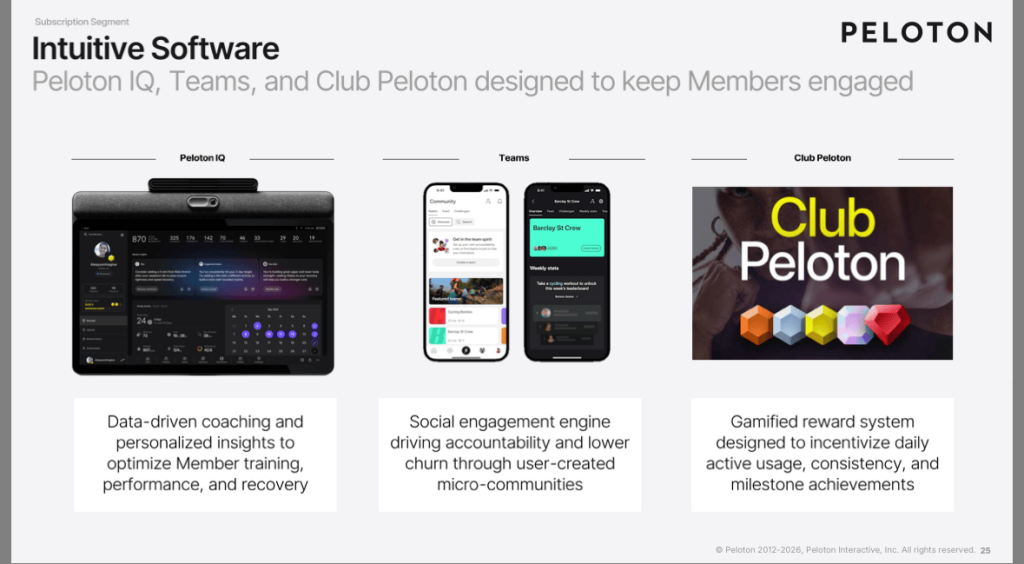
Peloton’s subscriber count is declining. The company knows it, has said so publicly, and has a plan for managing through it. At the center of that plan is a set of Peloton software features: three tools that Peloton’s Q3 FY2026 earnings presentation named as its primary engagement and retention infrastructure, and among the most important Peloton software features the company has built to date. Those features are Peloton IQ, Teams, and Club Peloton.
Each serves a different purpose. Together, they form a system designed to make leaving Peloton feel like giving up more than just a workout subscription.
Peloton IQ: The Personalization Layer
Peloton IQ is the data and coaching layer of the platform, and one of the most advanced Peloton software features available today. It delivers personalized insights based on a member’s workout history, output trends, and performance patterns. The most advanced IQ capabilities, including Rep Tracking, Form Feedback, Suggested Weights, and Hands-Free Control, are available on the Cross Training Bike+, Tread+, and Row+.
For members on any Peloton device, IQ also delivers Personalized Plans: weekly workout roadmaps built around individual goals and preferences. The Workout Generator takes that further, letting members skip the planning entirely. Choose a time, a muscle group, and a difficulty level, and the platform builds the session. Performance Estimates and Personalized Recommendations round out the experience, giving members ongoing feedback that evolves as their fitness does.
The goal is continuity and the feeling that the platform knows a member and is actively helping them improve. That kind of personalization is what separates a subscription that feels essential from one that is easy to cancel, and it is one of the most individually tailored Peloton software features on the platform.
Teams: The Social Layer
Peloton Teams is one of the community-focused Peloton software features designed to serve as the accountability layer of the platform. It creates user-formed micro-communities where members hold each other accountable, share milestones, react in real time, and generate the kind of social connection that makes a workout feel like more than a solo activity.
The numbers behind the feature reflect real adoption. According to Peloton’s internal data as of February 1, 2026, more than 395,000 members belong to at least one Team. Over 113,000 Teams have been created worldwide, and members have completed more than 78,000 Team challenges.
Teams can be formed around anything: location, identity, interests, or shared goals. Peloton also offers instructor-led Teams, giving members a direct community connection with the people teaching their classes. Members interact through a Community Feed where they can share photos, drop links, and cheer each other on in real time.
The earnings deck framed Teams explicitly as a social engagement engine that drives accountability and reduces churn. The causal logic is direct: members who have community on the platform have more reasons to stay.
Club Peloton: The Rewards Layer
Club Peloton is the gamification and loyalty layer, and one of the Peloton software features most directly designed to reward consistency and daily activity. It works through a structured points system with 11 total levels across five tiers: Bronze, Silver, Gold, Champion, and Legend.
Points accumulate through workout days, weekly and yearly streaks, milestones, community engagement including high fives and live classes, and participation in programs, plans, and challenges. As members climb through tiers, they unlock apparel and accessory discounts, instructor shoutouts, milestone alerts, first access to on-demand content, and invites to exclusive events.
The program’s most visible mechanism may be its exclusive live classes. Since launching in late 2025, Club Peloton has run a series of tier-gated live events. The Club Peloton Silver class opened access to Silver members and above. The Denis Morton Gold exclusive class targeted Gold members specifically. Each event creates a concrete incentive to maintain or increase membership activity.
One detail that mattered at launch: Peloton backdated workout history when Club Peloton rolled out, meaning many longtime members started the program already at elevated tier levels. That design decision rewarded existing loyalty immediately rather than making veteran members start from zero.
For a full breakdown of tier structure and benefits, The Clip Out’s Club Peloton tiers explainer covers the complete system.
How the Peloton Software Features Work Together
Individually, each of these Peloton software features targets a different reason members leave. IQ addresses the feeling that the platform has stopped challenging or surprising them. Teams addresses the loss of community and accountability that would come with canceling. Club Peloton addresses the logic of progress. The higher a member’s tier, the more they stand to lose by walking away.
Framing all three Peloton software features together on a dedicated slide in the Q3 investor presentation was deliberate. These are not casual feature announcements. They are Peloton’s answer to a direct question from investors: what keeps members paying when subscriber growth has stalled?
The AI Dubbing Pilot
Tucked into the same section of the earnings deck, alongside the three core Peloton software features, was a detail that got less attention: Peloton is piloting AI dubbing to translate its content into additional languages more efficiently. The platform currently offers localized content in three languages. AI dubbing, if it scales, could significantly reduce the cost of reaching non-English-speaking markets.
This matters more than it might appear on the surface. Peloton’s global commercial footprint spans more than 60 countries. The Peloton Spotify content licensing deal reaches most markets where Spotify operates. But instructor-led class content has historically been an English-language product with limited translation. AI dubbing removes that bottleneck without requiring Peloton to build multilingual instructor teams in every market.
What This Means for Global Growth
The pilot is early-stage. But the direction is clear. Peloton is building a platform that holds existing members through its Peloton software features and reaches new ones globally through technology-assisted content localization. The software strategy answers the near-term question of why current members stay. AI dubbing is the early answer to where new members come from next.
Those are two different problems, and Peloton is now publicly working both at the same time.
The Clip Out is an independent Peloton news site with reporting, analysis, and community insights. We deliver breaking updates, feature reporting, and expert context on the stories driving the community and the industry.
Our weekly podcast offers deeper conversation and perspective, and you can find us on Apple Podcasts, Spotify, iHeart, TuneIn, and YouTube Music. You can also follow us on our socials on Facebook, Threads, Instagram, BlueSky, and YouTube.
See something in the Peloton universe that you think we should know? Visit us at theclipout.com and submit a tip.
About the Author: Jen Kern

Latest Podcast


Subscribe
Keep up with all the Peloton news!