

Empowered at Every Age: How Midi Health Is Transforming Menopause Care for Women Like Christine D’Ercole
Hair on the chin. Hair in the ears. Night sweats, forgetfulness, and sleepless nights. For Peloton instructor Christine D’Ercole, these were confusing, isolating symptoms she shares in a vulnerable instagram post. She did not immediately connect these experiences to the onset of menopause. She sat on her porch, opened her laptop, and booked a virtual appointment. What happened next changed everything.
“I was seen, and I was heard,” she shared. “Sitting right here on my porch on the computer with a Midi clinician who listened and gave me all of the options.”
That moment of connection led Christine to become an official partner of Midi Health, one of the fastest-growing telehealth platforms in the country. And if you know Christine, you know this partnership makes perfect sense.

What Is Midi Health?
Midi Health is a virtual care clinic built specifically for women in midlife, offering specialized treatment for the symptoms of perimenopause, menopause, and other health challenges women commonly face over the age of 35. Founded by women over 40 who understood the gap in care firsthand, Midi Health has grown into the largest virtual clinic of its kind, with a network of more than 500 clinicians serving approximately 230,000 patients across all 50 states.
What makes Midi Health stand out in a crowded wellness landscape is a combination of accessibility, expertise, and compassion. Virtual visits are covered by most major insurance plans, and for those without coverage, initial appointments start at $250, with follow-ups at $150. Most patients with insurance pay an average of $50 per visit. Midi also recently achieved unicorn status, hitting a $1 billion valuation after raising $100 million in Series D funding, a signal of just how urgently women need and want this type of care.
Clinicians at Midi are board-certified nurse practitioners, nurse midwives, physicians, and naturopathic doctors who specialize in women’s midlife health. They complete more than 50 courses through an internal training program called Midi University, and participate in weekly lectures to stay current on the latest science. Every treatment plan is personalized to the individual patient’s symptoms, history, and goals.
The care model covers a wide range of concerns: hot flashes, brain fog, sleep disruption, mood changes, weight gain, low libido, joint pain, hair changes, and skin health. Treatment options include hormone replacement therapy in various forms such as patches, pills, gels, creams, and vaginal products, as well as non-hormonal medications, GLP-1 medications for weight management, supplements, and lifestyle coaching that encompasses nutrition, exercise, mindfulness, and stress management.
Midi recently launched an expanded prescription skincare line formulated specifically for the hormonal skin changes that begin in a woman’s 30s and accelerate through menopause. They have also introduced an AgeWell Longevity program that combines advanced testing, biomarker tracking, and personalized planning for proactive, 360-degree aging support.
Perhaps most importantly, Midi Health built its entire model around something women have long been denied in traditional healthcare: being truly heard. Initial visits are 30 minutes long, follow-ups are 15 minutes, and the digital platform allows patients to message clinicians at any time and receive a prompt response. For women who have spent years being dismissed, misdiagnosed, or rushed through appointments, the Midi experience can feel nothing short of revolutionary.

Midi Health Found the Right Partner in Christine D’Ercole
Christine D’Ercole is one of Peloton’s original cycling instructors, having joined the platform in 2014. She is also a Masters World Champion track cyclist, a motivational speaker, and the founder of Wordshop, a series of workshops centered on rewriting negative self-talk and reclaiming personal power through language. Her classes are rooted in science, grit, and what she calls the power of the inner monologue.
But Christine’s impact goes far beyond structured training and motivational mantras. For years, she has used her platform to speak openly about the physical and emotional realities of aging as a woman. She has talked candidly about pelvic floor health, hormonal changes, bladder leakage during workouts, and the often-unspoken ways that midlife affects the body. When she experienced a leak during a box jump at the gym, she turned to Instagram to share it, and was flooded with messages from women who recognized themselves in her story. That willingness to be vulnerable, specific, and honest is what makes Christine such a trusted voice in her community.
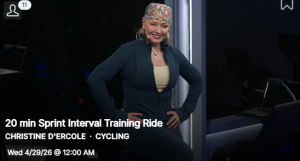
She was also a central figure in the groundbreaking Peloton x ReSpin initiative. ReSpin Health, the holistic menopause care platform, partnered with Peloton in 2025 during World Menopause Awareness Month to launch the PRESS study, short for Peloton/ReSpin Exercise and Symptoms Study. The research invited 500 Peloton members between the ages of 40 and 65 who were experiencing perimenopause or menopause symptoms to follow an eight-week targeted exercise program and track the impact on their symptoms, including sleep disruption, mood changes, and energy fluctuations. Christine was one of the lead instructors for that program, co-creating classes alongside Susie Chan, Joslyn Thompson Rule, and Charlotte Weidenbach. The study’s results were celebrated at a live event at Peloton Studios New York in January 2026, where Christine led a Sprint Interval Training class and participated in a panel discussion alongside ReSpin experts examining what the data revealed about movement and menopause.
Sprint Training Is Not Just About Speed — It’s About Survival at Midlife
One of the most important tools Christine has championed for midlife women is Sprint Interval Training, a format defined by short, powerful bursts of high-intensity effort followed by longer periods of recovery. This is not just a fitness trend. Sprint interval training targets neuromuscular power in ways that steady-state cardio cannot, and for women navigating hormonal changes, that distinction matters enormously.
Research shows that high-intensity interval training and sprint work can support bone density, improve metabolic function, enhance cardiovascular health, and help manage the weight shifts that often accompany the hormonal fluctuations of perimenopause and menopause. Christine led both 20-minute and 30-minute Sprint Interval: Menopause classes as part of the Peloton x ReSpin menopause collection, classes built on more than 100 peer-reviewed studies curated by ReSpin Health’s clinical team. Many more classes have been added since then – you can find them in Peloton’s Sprint Interval Collection.
What Christine understands, and what makes her such a credible guide, is that these classes are not just about what happens on the bike. They are about proving to yourself, again and again, that your body is capable. That the changes happening to you do not have to define your limits. That showing up, turning it up, and not giving up are skills that translate off the bike and into your actual life.
“You Deserve to Feel Like Yourself”
When Christine shared her Midi Health story on Instagram, she was not reading from a script. She spoke from her porch, plainly and personally, about symptoms she did not recognize, about the fear that this was all just her new normal, and about the relief of finally sitting with a clinician who listened without rushing her out the door.
“I had no idea any of that was the onset of menopause,” she said. “I thought it was never gonna happen to me. I learned it will happen to all of us in one way or another.”
She described being on her porch with her laptop, connecting with a Midi clinician who gave her all of her options. She was not handed a pamphlet or told to wait and see. She was seen. She was heard. And in her words, being seen and heard is powerful medicine.
That message resonates so deeply because it is not the language of a sponsored post. It is the language of a woman who has spent her career telling other women the truth, even when the truth is uncomfortable.
If you are experiencing symptoms you cannot explain, if your sleep has changed, if your moods feel unfamiliar, if your body seems to be operating on a different set of instructions than you were given, know that you are not alone and that there is care available that will actually meet you where you are.
Book a visit with a menopause specialist. Ask all the questions. Tell them everything. You deserve answers. You deserve to feel like yourself.
The Clip Out is an independent Peloton news site with reporting, analysis, and community insights. We deliver breaking updates, feature reporting, and expert context on the stories driving the community and the industry.
Our weekly podcast offers deeper conversation and perspective, and you can find us on Apple Podcasts, Spotify, iHeart, TuneIn, and YouTube Music. You can also follow us on our socials on Facebook, Threads, Instagram, BlueSky, and YouTube.
See something in the Peloton universe that you think we should know? Visit us at theclipout.com and submit a tip.
About the Author: Liz Nikol (#JustAskForHelp)

Latest Podcast


Subscribe
Keep up with all the Peloton news!