

The Matt Wilpers Periodization Plan Hits Its 2nd Peak
Where the Matt Wilpers Periodization Plan Stands at Midyear
The Matt Wilpers periodization plan has been building since January, and halfway through 2026, the picture is clear. During his July 10 live Power Zone class, Wilpers walked riders through exactly what the rest of the year looks like, month by month, tying it back to the base-building and first-peak work members have already put in.
We’ve been tracking this (and doing all the rides!) since January and if you’re just tuning in, click here to see the background.

For anyone who has followed the plan from the start, here is Matt’s own rundown of what comes next, in his words from the July 10 class:
So again, July, we’re in a sustain and maintain fitness month. Great time to retest if you feel like your zones are out of whack. August, second of two peaks for the entire year. So after August and me smacking you around, you don’t have to deal with that for the rest of the year.
So get your fill, baby, get your fill, all right? Because I’m going to be nice the rest of the year. You’re going to be like, oh, I miss mean Matt. I already tell you what’s going to happen. You’re going to be like, where’s mean Matt at? I don’t know. Gone, gone until next year. (If you can hear him laughing at this point and you’re laughing too, you’re in the right place!)
OK, and again, I try to time our periodization for when everyone’s doing events and stuff. So if you’re training for life, you’re going to get great training. But if you’re training for events, I want you to use the training we’re doing here as a jumping off point, OK?
September, after our next peak, we’re going to be doing an aerobic reset, another great time to retest. Base 2, we’re going to be focusing on strength and endurance in October. We’re going to do a maintenance month in November, and then we’re going to do a transition month in December. We’re going to work on transition. Then January comes around, and we go through all the phases of base training.
Very diligent students of Professor Wilpers may notice a slight deviation in the framing of the months, as July as also called an “absorption” month and previously he was calling September a “return to basics.” The work is the same, but the lens is a little different. Especially as he has us doing more Zone 5 in July than I was expecting!
Another gem he dropped came the next day, on his live 7/11/26 60 Minute Power Zone Ride. He said that there will be a special class in August that is going to be an alternative to the traditional FTP test rise. Say less!
And if you are wondering where to tune in to hear these pearls of wisdom, they come on his live classes, currently the Friday and Saturday morning Power Zone rides. Though we hope and expect to see this plan organized and presented more fully at year’s end, currently it’s shared directly from the source in real time. But don’t worry, we’ve got you here at The Clip Out!
July: Sustain and Maintain
July is a holding pattern by design. Wilpers described it as a sustain and maintain month, meaning the goal is consistency rather than another hard push. It is also, in his words, a great time to retest your FTP if your zones feel off, giving riders a natural checkpoint before the next peak block begins.
August: The Second Peak Arrives
August marks the second of two peak blocks in the yearlong Matt Wilpers periodization plan, following the first peak in June. Matt was direct about what that means for riders: expect the intensity to climb, and expect it to be the hardest stretch remaining on the calendar. He was equally direct that this is the last hard peak of the year.
After August, the plan shifts toward maintenance and recovery through the end of 2026. He also tied the timing to real-world racing, telling riders that if they are training for events rather than general fitness, this block is meant to serve as a jumping-off point for whatever comes next on their own calendar.
Another Way to Test: The August Power Profile Ride
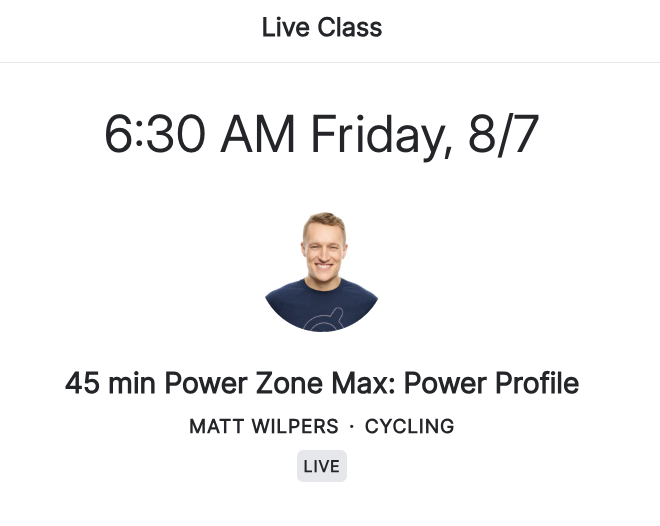
In the ride the following day, Wilpers said August will also include a Power Profile ride, a format that tests riders across multiple effort durations rather than a single sustained 20-minute FTP test. We first covered this format back in 2023, when Matt introduced it as a way to show riders where their strengths sit across sprint, anaerobic, and endurance efforts, not just at threshold.
Personally, my FTP has been trending up this year (after some plateaus and dips over the last six years!) and testing it against a Power Profile ride sounds like a useful way to see that progress from a different angle.
We see this ride is currently displaying on August 7 as a 45-minute Power Zone Max Power Profile Ride at 6:30am ET.
September Through December: Reset, Rebuild, Recover
After the August peak, September brings what Wilpers called an aerobic reset, along with another opportunity to retest.
October moves into what he referred to as Base 2, shifting focus to strength and endurance. November is a maintenance month, and December closes the year with a transition month heading into the next base-building cycle. That built-in recovery is intentional: it mirrors the principle behind the deload and reset framework Matt has taught members to recognize on their own.
Looking Ahead to January
When 2026 comes to a close, our current training plan concludes but doesn’t end. Matt confirmed the cycle starts over once the calendar flips. In January, the plan returns to base training, running through all the same phases that opened 2026. Riders training for specific events can use the current structure as a jumping-off point, while riders without a race on the calendar still get the benefit of a full year of structured, progressive training.
What’s on the agenda for 2027? I can’t wait to find out. Seriously.
Why the Matt Wilpers Periodization Plan Works
The structure behind the Matt Wilpers periodization plan is not unique to Peloton. Coaches have used cycles of building, peaking, and recovering for decades because the approach consistently outperforms training at a constant, undifferentiated effort.
The American Council on Exercise notes that periodization works by cycling training volume, intensity, and complexity in structured phases, using built-in rest to let the body adapt to the demands placed on it. That is effectively what Wilpers has mapped across the Peloton calendar: base phases to build the aerobic engine, peak phases to sharpen threshold and power, and reset or maintenance phases that let those gains settle in before the next push.
The practical benefit for members is fewer plateaus and less risk of burnout. Riders who train at maximum effort every session tend to stall out, while riders who follow a structured cycle get repeated, planned opportunities to retest and see real progress. Whether or not you’re training for a specific event, the Matt Wilpers periodization plan gives the rest of 2026 a clear shape, right through the next base phase in January.
If you haven’t been riding along but want to join the fun, now it s great time to jump in before August heats up!
The Clip Out is an independent Peloton news site with reporting, analysis, and community insights. We deliver breaking updates, feature reporting, and expert context on the stories driving the community and the industry.
Our weekly podcast offers deeper conversation and perspective, and you can find us on Apple Podcasts, Spotify, iHeart, TuneIn, and YouTube Music. You can also follow us on our socials on Facebook, Threads, Instagram, BlueSky, and YouTube.
See something in the Peloton universe that you think we should know? Visit us at theclipout.com and submit a tip.
About the Author: Elizabeth Schlosberg

Latest Podcast


Subscribe
Keep up with all the Peloton news!