

Marathon Recovery Wisdom Robin Arzon Shared on Medal Monday
The Peloton instructor opens up about the post-marathon blues, the injury window runners overlook, and how to ease back into training

Marathon recovery is about more than sore legs, according to Peloton instructor Robin Arzon. In an Instagram Reel shared on Medal Monday, the day after the 2026 TCS New York City Marathon, Robin wore her medal and spoke openly about the post-marathon blues, the injury window most runners overlook, and how she is spending the week ahead.
Her first piece of advice was simple: wear your medal proudly. The rest of her marathon recovery approach covers both the physical and emotional side of finishing 26.2 miles, and it applies whether race day went to plan or not.
View this post on Instagram
The Post-Marathon Blues Are Real
Robin opened with a part of marathon recovery she says rarely gets attention. “The week after a marathon is not something people often talk about,” she said, describing the stretch as the post-marathon blues.

She pointed to two causes. The first is processing a race that did not go as planned, something she said she has been through herself. The second is the sudden absence of a goal. After devoting six months, nine months, or even a year of training to one event, runners can be left wondering where to put that energy once it is done.
Her answer is to redirect it toward the people and projects that took a back seat during the training block. “I try to put my energy into the family that I’ve probably neglected,” she said. This year, that means going full force into holiday decorating, ordering gifts, and getting festive.
Robin Arzon’s Marathon Recovery Rule for Raw Emotions
Journaling is another tool Robin recommends for the emotional side of marathon recovery. She also uses a simple gauge to check in with herself: if her quads still feel thrashed, her emotions are probably still raw, too. On the day she filmed, that meant taking the stairs backwards.
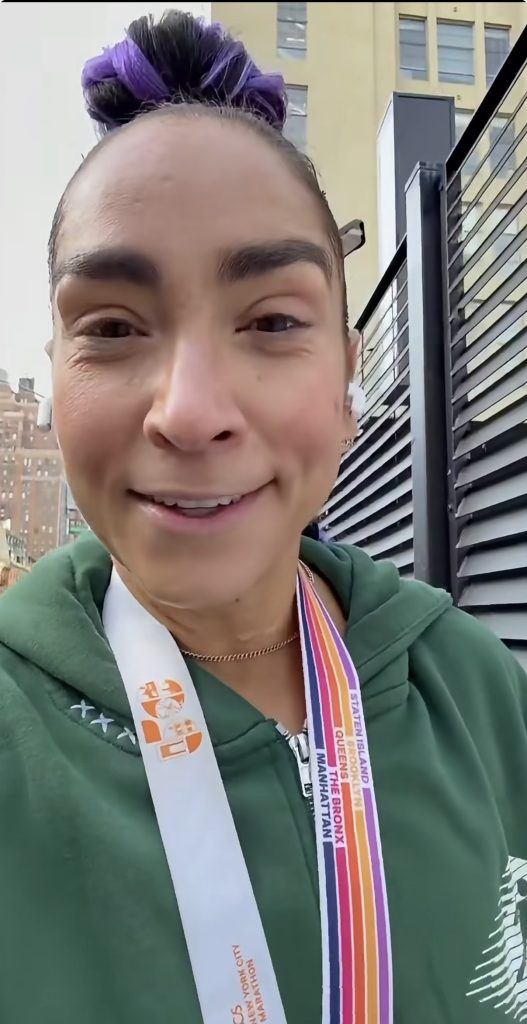
Her point is that there is no need to rush past the experience. Robin said that fast-forwarding to the next thing too quickly skips an important step, and that it is okay to sit with the moment for a while.
She also cautioned against putting too much stock into one finish line. One of the encouraging parts of life as an athlete, she said, is the ability to play the long game.
A Gentle Marathon Recovery Movement Plan
Robin’s own plan for the week is intentionally light:
• Daily steps and gentle movement
• Possibly some upper body strength midweek or later in the week
• Easy, conversational runs when she returns to running
She was clear that marathon recovery does not wrap up in a few days. “Your body needs weeks to properly recover from a marathon,” she said.
For Peloton members coming off a fall race, that approach lines up with Walking, Stretching, Yoga, and upper body Strength classes in the first days of marathon recovery, with Tread and Outdoor runs added back gradually.
Weeks Two and Three Carry the Most Injury Risk
One of the most useful points in the Reel is about timing. According to Robin, injury is actually most likely in weeks two and three of marathon recovery, when the soreness has faded but the body’s systems are still coming back online. Feeling good is not the same as being fully recovered.
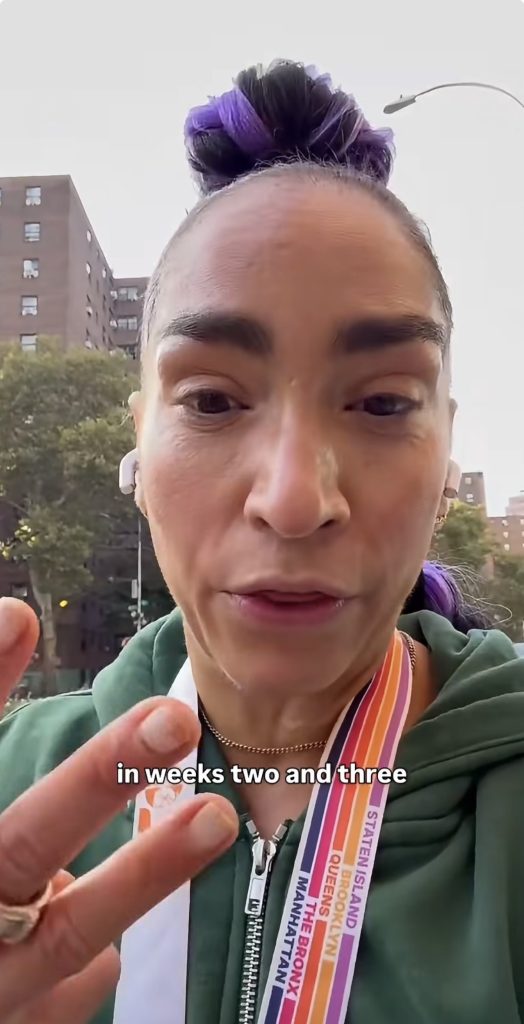
Her guidance is to ramp up gently. Those first few runs back should be easy and truly conversational, with nothing to prove. Treating that window as part of marathon recovery, rather than the start of a new training block, gives the body time to finish rebuilding.
Perspective After a Marathon
Robin closed with a reminder about scale. She noted that less than 1% of people in the world complete a marathon. Inside the running world, she said, it is easy to develop a distorted view of how fast or how far everyone should be going, to the point where it can feel like everyone else is a five-minute miler and you are falling behind.
Her message to anyone finishing a race this season was direct: “What you’ve done is absolutely incredible, so don’t forget that.”
It is the same mindset Robin has shared throughout her years at Peloton and in her book Shut Up and Run. Members who want to relive the course can take Peloton’s TCS NYC Marathon classes on the Tread once their marathon recovery allows.
Her advice treats marathon recovery as part of the race rather than an afterthought. The legs heal over a few weeks, and the post-marathon blues tend to fade with time. What lasts is the perspective a runner carries forward, and Robin’s version puts the medal, the family, and the long game ahead of the next finish time.
The Clip Out is an independent Peloton news site with reporting, analysis, and community insights. We deliver breaking updates, feature reporting, and expert context on the stories driving the community and the industry. Our weekly podcast offers deeper conversation and perspective, and you can find us on Apple Podcasts, Spotify, iHeart, TuneIn, and YouTube Music. You can also follow us on our socials on Facebook, Threads, Instagram, BlueSky, and YouTube. See something in the Peloton universe that you think we should know? Visit us at theclipout.com and submit a tip.
About the Author: Jen Kern

Latest Podcast

Subscribe
Keep up with all the Peloton news!