
Peloton Music Changes Frustrate Members
Peloton music changes: songs are being swapped out of already-recorded classes, and instructor audio is being muted in the process. Members have theories about why.
Peloton members are noticing something unsettling: songs are disappearing from classes they have taken before, replaced by different tracks, and in some cases instructor audio is being muted mid-class as a result. The Peloton music changes are showing up across multiple modalities and instructors, and the community is pushing back.
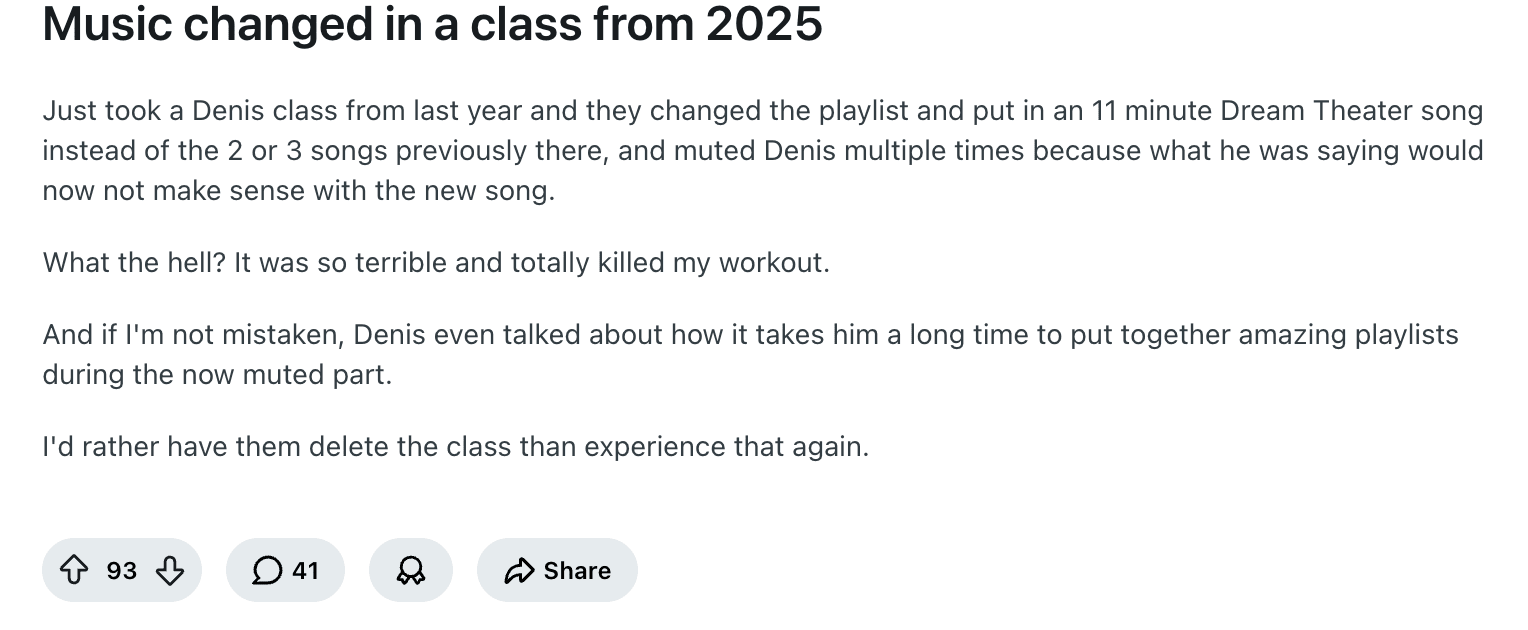
One of many posts on this topic in Reddit, but this was the impetus for this article.
What Members Are Experiencing with Peloton Music Changes
The complaints surfaced recently in community discussion threads, where members described returning to saved or previously taken classes only to find the playlists significantly altered. In one reported case, two or three songs in a Denis Morton class were replaced by a single 11-minute Dream Theater track. Because the instructor’s verbal cues had been recorded around the original songs, portions of his audio were muted where his commentary no longer matched the new music.
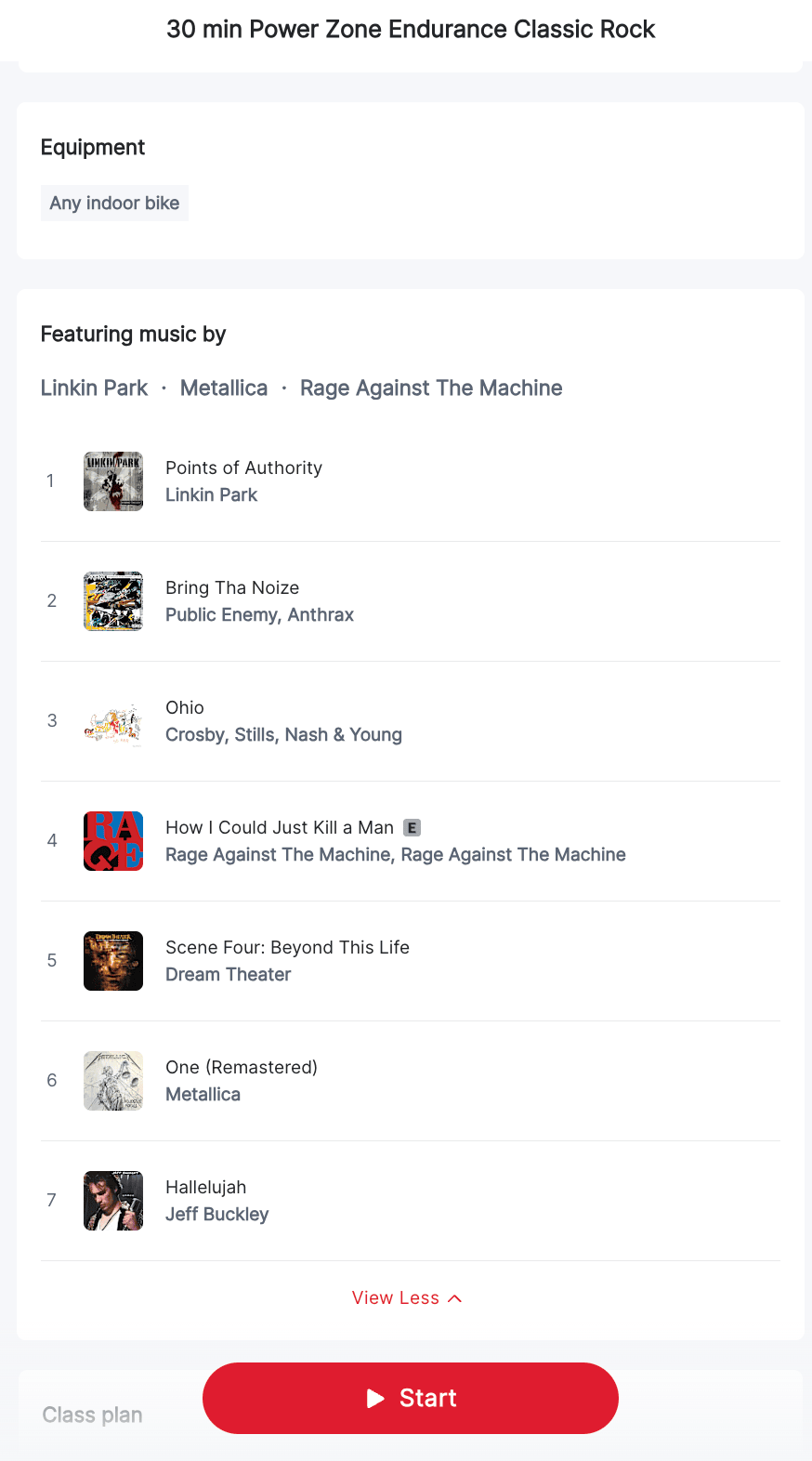
The Denis class in question… I happen to take a lot of his rides and I’ve never heard him play this artist.
“It was so terrible and totally killed my workout,” one member wrote. Another added that Denis had spoken during the class about how long he spends curating playlists, and that section of his audio was among the parts that got silenced.
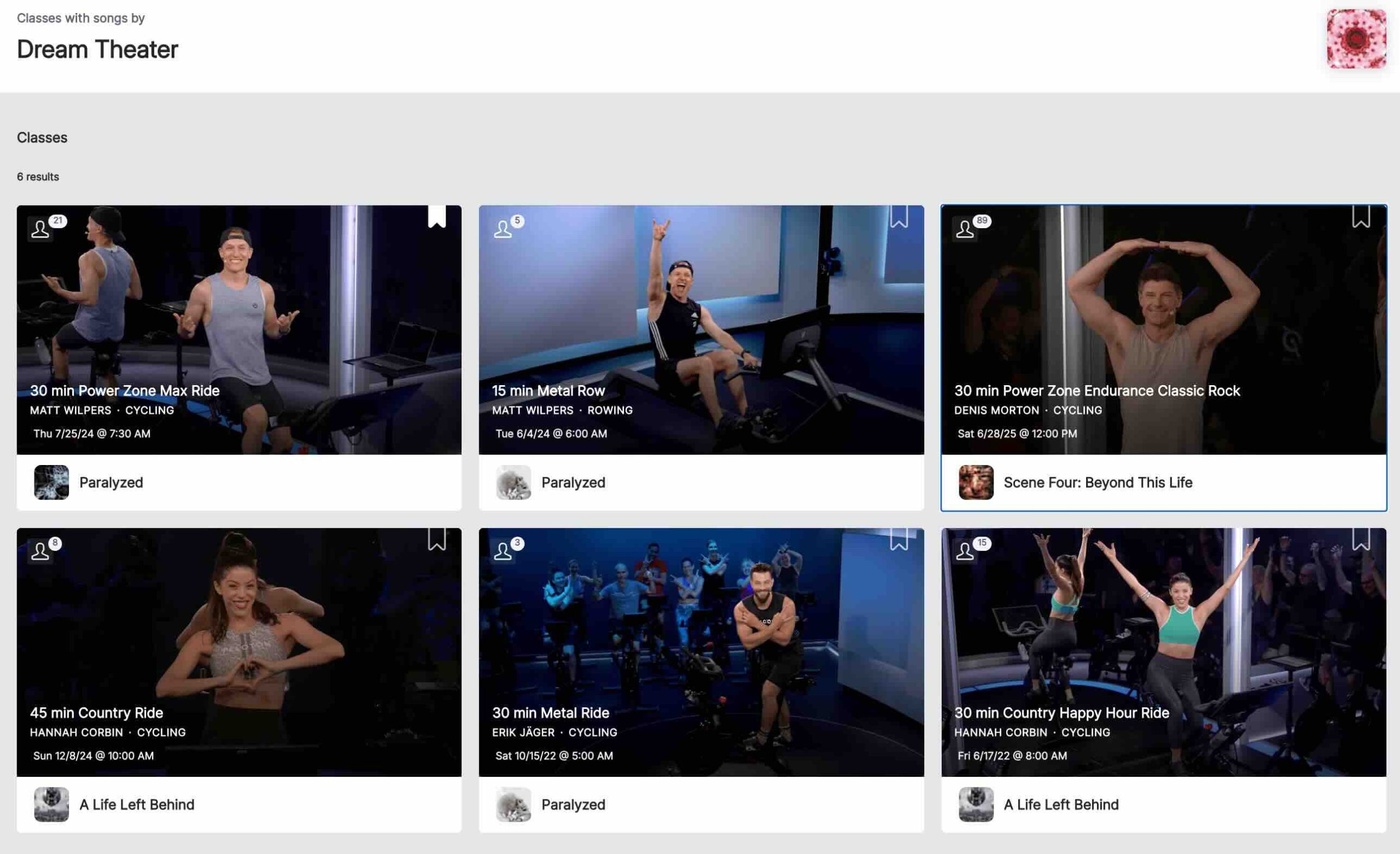
Out of curiosity I did a search of this artist and found these six classes – hard to know who actually programmed their music intentionally but I’m going to guess just the two Metal classes, and maybe Matt’s PZ Max Ride… because… Matt (haha).
The issue is not limited to one instructor. Members also reported similar Peloton music changes in classes taught by Mariana Fernández, where a Rage Against the Machine song was swapped for a Metallica track. Instructor commentary referencing the original song, including remarks about RATM vocalist Zack De La Rocha, was muted in the process.
An Audioslave track in the same class was reportedly replaced by a Nick Cave song, leaving an abrupt gap in the audio and a moment where the instructor mentioned Audioslave despite the song no longer being in the class. A separate report described a Jess King class where a RATM track was also replaced by Metallica, but the original song could still be heard through the instructor’s microphone during the swap.
The reaction in community spaces has been pointed. “Better to pull the run than swap out songs,” one member wrote. “The noticeable decline in the music aspect of Peloton has been a massive disappointment,” said another.
The Theories About Peloton Music Changes: Licensing, Spotify, or Both?
Members have put forward several explanations for the Peloton music changes, though none have been confirmed by Peloton.
The most straightforward theory is music licensing. Peloton has a well-documented history with music rights, including a lawsuit settled years ago over sync licensing for on-demand content. Music licenses expire, and when they do, Peloton has historically had to pull classes or replace tracks. That history makes licensing the first instinct for many members when a familiar song disappears.
A second theory, which gained significant traction in community discussion, ties the changes to Peloton’s recently announced Spotify partnership. That deal, which launched April 27, 2026, places more than 1,400 Peloton classes inside Spotify’s fitness category, available to Spotify Premium subscribers worldwide. The classes available through the partnership are floor-based and outdoor modalities, not cycling content.
Some members speculated that Peloton created Spotify-compatible versions of existing classes with swapped music and then pushed those versions to all app users rather than maintaining separate libraries. One member noted that a class they had bookmarked the previous month, which seemed too recent to involve an expired license, had already received the treatment and turned up on Spotify shortly after. “Every class I’ve noticed with this issue is now available as part of the new Spotify partnership,” the member wrote, though this has not been verified independently.
The Spotify theory would explain the timing, given how recently that partnership launched, but it raises its own questions. As one community member put it: “You’d think they’d want people to take the classes on Spotify and then get curious enough to check out a Peloton subscription. How are they going to do that if they mute the instructors and put in goofy music?”
A third possibility about Peloton music changes, is that Peloton is testing lesser-known or independent artists in existing class slots, either to reduce licensing costs or to surface new music to members.
What Peloton Has Said
The response confirms that Peloton is intentionally making music changes to floor and outdoor classes and frames the substitutions as an expansion of content variety. It does not address the muting of instructor audio, the disruption to class cueing, or why members who previously took a class in its original form are now receiving a different version without notice. It also specifically references floor and outdoor classes, though member reports include a Bike and Tread class among those affected.
Peloton has not issued any broader public statement on the changes.

The Bigger Picture
Music has always been central to the Peloton experience. Instructors build classes around specific tracks, cue movements to song structure, and frequently speak to the music in ways that are woven into the class itself. When the music changes after the fact, the class changes with it, and not always in ways that hold together.
Whether the driver is licensing, the Spotify rollout, a cost-cutting strategy, or some combination, the member response signals that this is not a minor issue. The classes people save and return to are often ones with specific playlists that matter to them. Swapping music after the fact, especially without flagging the change, cuts against one of the things members value most about the platform.
For more background on Peloton’s long history with music licensing, The Clip Out has a full explainer here. For details on the Spotify partnership that may be at the center of this, read our full coverage here.
>Has this happened to one of your favorite classes? Drop a comment below and tell us which class and what changed.
The Clip Out is an independent Peloton news site with reporting, analysis, and community insights. We deliver breaking updates, feature reporting, and expert context on the stories driving the community and the industry.
Our weekly podcast offers deeper conversation and perspective, and you can find us on Apple Podcasts, Spotify, iHeart, TuneIn, and YouTube Music. You can also follow us on our socials on Facebook, Threads, Instagram, BlueSky, and YouTube.
See something in the Peloton universe that you think we should know? Visit us at theclipout.com and submit a tip.
About the Author: Elizabeth Schlosberg

Latest Podcast


Subscribe
Keep up with all the Peloton news!