
The Estrogen Patch Shortage: What Every Woman Needs to Know Right Now
Here at The Clip Out, we love talking perimenopause and menopause. You may have seen some of our stories about training in midlife or about Peloton’s commitment to helping women live their longest and healthiest lives through their menopause health collection and partnership with Respin. Today we are diving into a topic that has been making headlines and frustrating women at pharmacy counters across the country: the estrogen patch shortage.
You finally got the prescription. Maybe it took months of advocating for yourself with a doctor, or maybe a telehealth platform made it easier than you expected. Either way, you walked into the pharmacy ready to start feeling better, and the shelf was bare. If that sounds familiar, you are far from alone. The estrogen patch shortage has become one of the most talked-about women’s health issues of 2026, and understanding how we got here might make you equal parts hopeful and furious.
Let’s break it all down.
How the WHI Study Derailed a Generation of Women’s Health Care
To understand the estrogen patch shortage today, you have to go back to 2002. The Women’s Health Initiative (WHI) was a large, government-funded clinical trial that enrolled more than 16,000 postmenopausal women between the ages of 50 and 79. Participants received conjugated equine estrogens combined with medroxyprogesterone acetate, or a placebo, and researchers tracked outcomes including coronary heart disease and breast cancer over an average of 5.2 years.
The trial was stopped early. Interim monitoring of the combined estrogen and progestin treatment group indicated an increased risk of breast cancer, coronary heart disease, stroke, and pulmonary embolism, which outweighed evidence of benefit in preventing colorectal cancer and fractures. The headlines were alarming, and the fallout was immediate. Hormone therapy prescriptions plummeted practically overnight.
Here is where it gets complicated and, honestly, a little maddening. Initial interpretation and communication about the study’s findings have been criticized for failing to clarify that the participants were weighted toward women already 60 or older, with an average age of 63. That is a crucial detail because the average woman starting hormone therapy is in her late 40s or early 50s, not her mid-60s. Subsequent studies from the WHI and others clearly showed that younger women and those close to menopause had a very beneficial risk-to-benefit ratio, with similar protective effects for coronary disease and a reduction in mortality.
Put simply: the study was conducted mostly on older women with different risk profiles, and its conclusions were applied broadly to all women. The WHI was performed with only one type of oral continuous combined hormone therapy, yet the results were applied to all types performed with different estrogens, progestins, and routes of administration. It would be like testing one type of blood pressure pill on 70-year-olds and then telling everyone of all ages and circumstances to avoid the entire drug class.
The FDA’s Historic Black Box Decision
For over 20 years, every HRT product carried a black box warning, which is the FDA’s most serious safety label. It warned of risks including cardiovascular disease, breast cancer, and probable dementia. And for over 20 years, countless women were denied treatment, or simply too scared to ask for it.
That finally changed. On November 10, 2025, the FDA announced the initiation of the removal of these warnings from all menopausal hormone therapy products, including systemic and low-dose vaginal preparations, citing outdated interpretations of early WHI findings that overstated risks in older women.
The decision did not come out of nowhere. In July 2025, an expert panel (#MenoPosse) on menopause and hormone replacement therapy was hosted by the FDA, focusing on the risks and benefits of these therapies, including potential risks of breast cancer, uterine cancer, and certain cardiovascular risks versus potential benefits on bone, genitourinary, cardiovascular, and cognitive health. Following that review, the FDA initiated the removal of the warnings in November 2025 after a comprehensive review of the scientific literature, and at the FDA’s request, 29 drug companies submitted proposed labeling changes. Those updated labels officially took effect in February 2026.
One important note: while many of the black box warnings for menopausal hormone replacement therapy are being removed, the FDA is not seeking to remove the warning for endometrial cancer for systemic estrogen-alone products. Women with a uterus who use estrogen alone should still discuss that specific risk with their doctor.
The Benefits of HRT That Were Ignored for Decades
Here is what women were not hearing enough about during those 20-plus years of fear-driven messaging. The benefits of HRT extend well beyond managing hot flashes and night sweats, and they are significant. They also relate to the Peloton world and our ability to stay active.
Heart Health
Evidence shows that taking HRT reduces the risk of cardiovascular disease, including heart attack and stroke, and can also help lower cholesterol levels, which reduces the risk of heart disease. These benefits are greatest if started within ten years of menopause. The FDA’s own fact sheet reflects this updated understanding, noting that women who initiate HRT within 10 years of the onset of menopause may reduce their risk of cardiovascular diseases by as much as 50%.
Bone Protection
Taking HRT can help prevent and even reverse the bone loss that occurs due to low estrogen levels during and after menopause, making it less likely a woman will break a bone as a result of osteoporosis. According to the FDA, women who initiate HRT within 10 years of menopause onset may reduce bone fractures by 50 to 60%.
Brain and Cognitive Health
When started before a woman reaches menopause during the perimenopause transition, HRT reduces the risk of a problematic fuel switch in the brain and can cut a woman’s Alzheimer’s disease risk in half. The HHS fact sheet similarly cites research showing HRT may reduce the risk of Alzheimer’s disease by 35%.
Mood, Sleep, and Quality of Life
The ripple effects of hormone decline are vast. Estrogen receptors exist in a woman’s brain, bones, heart, and blood vessels, so its decline impacts multiple systems, causing cognitive decline, mood changes, and a higher risk for osteoporosis. HRT addresses symptoms at the source rather than just managing them one by one.
Lower Overall Mortality
Perhaps the most underreported finding: an analysis of 30 trials with 26,708 women participants found HRT was not associated with increased cancer mortality, and in fact, women who start HRT before age 60 appear to have a decreased mortality risk.
Why the Estrogen Patch Shortage Happened
So with all of that good news finally getting out into the world, what is the catch? More women started asking for hormone therapy, and the supply chain was not ready for them.
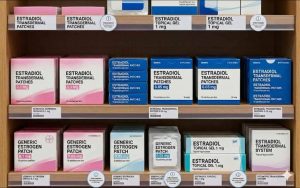
There has been an increase in estrogen prescriptions of 86% in the last five years, and 50% of those are for patches. Meanwhile, estradiol transdermal systems are produced by a limited number of pharmaceutical manufacturers. When production slows or demand rises faster than anticipated, there is very little redundancy to buffer the impact.
Estrogen patches are generic medicines with low profit margins, providing manufacturers few incentives to invest quickly in new production lines or facilities that can take years to build. The FDA’s removal of the black box warning in late 2025 was followed by a 26% jump in patch use through February 2026, according to data from health analytics company Truveta. That surge hit a supply chain that was already stretched thin, and industry sources say the shortage could last up to three years.

What You Can Do If You Cannot Find Your Estrogen Patch
Do not panic, and please do not start rationing your patches or cutting them in half. That is not safe and won’t give you consistent hormone delivery. Here are some practical options:
Call around to different pharmacies. Sometimes it is as simple as trying a different pharmacy, since different distributors supply different chains, and CVS may have something that Walgreens does not.
Ask your doctor about switching brands or dosing schedules. The hardest to find right now are Sandoz estradiol transdermal patches and several dosages of Dotti and Lyllana patches made by Amneal. Your doctor may be able to switch you to an in-stock patch with a slightly different dosing schedule if it is clinically suitable.
Consider other forms of transdermal estrogen. Patches are not the only form of transdermal estrogen available. There are also gels, creams, and sprays that go on the skin and use the same active ingredient.
Talk to your doctor about oral estrogen. Oral estrogen taken via pill is also a safe form of estrogen for many people depending on their medical history. For someone who does not have a history of blood clots, it can be a great option and has also been shown to lower cholesterol levels and reduce lipids, both great for heart health.
Try a telehealth menopause specialist. There are telehealth services that focus on hormone therapy specifically and connect patients with menopause specialists who can prescribe it, which can be especially helpful if you cannot find a local specialist quickly.
Try an online pharmacy. Cost Plus Drugs and similar platforms sometimes have stock when local pharmacies do not, and a prescription can often be transferred.
The bottom line is this: the estrogen patch shortage is real, frustrating, and may not resolve quickly. But options do exist. Work with your doctor, stay flexible about delivery methods, and know that after decades of being undertreated and under-informed, the science is finally on your side.
The Clip Out is an independent Peloton news site with reporting, analysis, and community insights. We deliver breaking updates, feature reporting, and expert context on the stories driving the community and the industry.
Our weekly podcast offers deeper conversation and perspective, and you can find us on Apple Podcasts, Spotify, iHeart, TuneIn, and YouTube Music. You can also follow us on our socials on Facebook, Threads, Instagram, BlueSky, and YouTube.
See something in the Peloton universe that you think we should know? Visit us at theclipout.com and submit a tip.
About the Author: Liz Nikol (#JustAskForHelp)

Latest Podcast


Subscribe
Keep up with all the Peloton news!