

Listening to Your Body in Competition: What Benny Adami and Erik Jager Teach Us
Listening to your body in competition is one of the hardest calls any athlete faces, and two Peloton instructors recently made that decision in a very public way. Benny Adami withdrew from HYROX London and HYROX Berlin before the starting gun, and Erik Jager stopped during a HYROX race before reaching the finish line. Both chose long-term health over a short-term result, and both talked about it openly with their communities.
Their stories are worth paying attention to, not just as headlines, but as real examples of what athletic self-awareness actually looks like when the stakes are high.
Benny Adami: Stepping Back to Move Forward
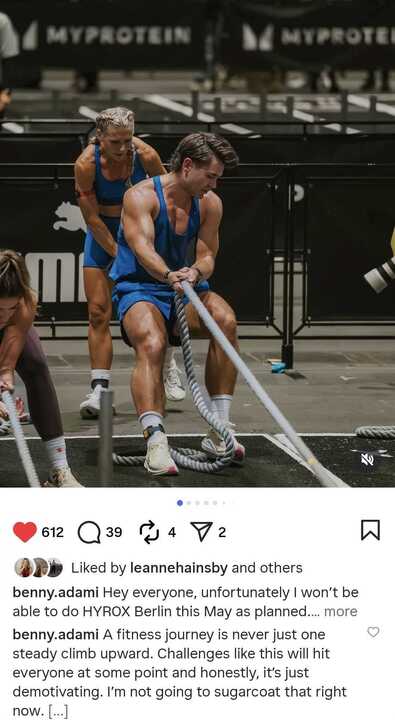
Benny Adami, Peloton’s German-language cycling instructor, announced that he would not be starting HYROX London Olympia 2026, which ran March 24 through 29. In a social media post, Adami stated directly that his body was pushing back and that he had asked too much of it. Rather than compete through the warning signs, he pulled out and redirected his focus to HYROX Berlin, scheduled for May 22 through 31, 2026.
This was not a small decision. Adami had planned to compete in multiple HYROX events in 2026, and London would have been his third. Choosing to sit it out meant reworking a significant part of his athletic calendar. But listening to your body in competition, and having the discipline to act on what it tells you, is what separates sustainable performance from repeated cycles of injury and recovery.
Berlin was his next target, as we covered here at The Clip Out, Benny named it as the milestone marking his road back. But, instead, he has decided his body is not where it needs to be for HYROX Berlin and will not be competing.
Erik Jager: The Courage to Stop Mid-Race
Erik Jager faced a version of this decision that is, if anything, even harder. He did not finish a recent HYROX race, making the choice to stop competing before crossing the finish line. In the world of endurance and hybrid fitness competition, a DNF carries a weight that most athletes dread. Jager addressed it openly anyway.
He was clear that continuing would have meant compromising his health. That is the heart of listening to your body in competition: recognizing in the moment, under pressure, with a finish line still ahead, that going further is the wrong call. Jager framed his decision not as defeat but as a reflection of the values he brings to his teaching on the Peloton platform. He encourages members to honor what their bodies are telling them rather than override those signals in the name of completion.
For anyone who has ever felt the pull to push through something they probably should not have, that message lands differently coming from someone who has done it at a competition level.
What the Science Actually Says
The decisions both instructors made are well supported by sports science research.
Research on endurance athletes shows that when adequate recovery is not provided, overtraining can result in measurable decrements in performance. The consequences extend beyond physical fatigue. More than 70 percent of athletes with non-functional overreaching and overtraining syndrome self-reported emotional disturbances, and researchers note that athletes are often the first to identify early warning signs themselves.
Key signals to watch for include persistent fatigue, changes in mood, decreased performance, and increased susceptibility to illness. Recognizing those signals and acting on them, as both Benny and Erik did, is not instinct alone. It is a developed skill.
Sports science consistently supports encouraging athletes to openly report signs of fatigue, stress, and mood disturbances rather than pushing through them. That is precisely what both instructors modeled, publicly and without hesitation.
Listening to your body in competition is not just a wellness talking point. The research treats it as a core component of long-term athletic health.
What HYROX Actually Demands
Understanding why these decisions carry so much weight requires knowing what HYROX puts athletes through. Every event follows the same standardized format worldwide: eight 1-kilometer runs, each followed by one of eight functional fitness stations. Those stations include ski ergs, sled pushes and pulls, burpee broad jumps, rowing, farmer’s carries, sandbag lunges, and wall balls. The combination of sustained cardiovascular effort and repeated functional strength work across a single course is demanding by design.
The physical demands of this format make recovery management critical, and they make listening to your body in competition all the more important when something feels wrong.
Want to Train for HYROX Using Peloton?
If Benny’s and Erik’s journeys have you thinking about HYROX for yourself, Peloton has a structured path to help you prepare. The platform launched a 12-week HYROX Training Program designed to build the specific blend of endurance and functional strength the race requires. The program is led by seven Peloton instructors, including Robin Arzón, Andy Speer, Adrian Williams, Logan Aldridge, Joslyn Thompson Rule, Ash Pryor, and Alex Karwoski, covering each of the eight functional stations with progressive weekly structure.

The Bigger Picture
What Benny Adami and Erik Jager both demonstrated is that the values Peloton promotes in the studio translate directly to real competition. Listening to your body in competition is not passive. It takes self-awareness, honesty, and the willingness to make an unpopular call when it matters most.
Both instructors were vocal about why they made the decisions they did. Both used their platforms to show what that looks like in practice. For the community watching, that authenticity carries real weight.
Benny is hoping to compete in Hamburg later this year. Erik’s road continues. And the lesson from both is worth holding onto: the decision that protects your long-term health is almost always the right one, no matter where you are in the race.
How have you pivoted in the face of physical adversity?
The Clip Out is an independent Peloton news site with reporting, analysis, and community insights. We deliver breaking updates, feature reporting, and expert context on the stories driving the community and the industry.
Our weekly podcast offers deeper conversation and perspective, and you can find us on Apple Podcasts, Spotify, iHeart, TuneIn, and YouTube Music. You can also follow us on our socials on Facebook, Threads, Instagram, BlueSky, and YouTube.
See something in the Peloton universe that you think we should know? Visit us at theclipout.com and submit a tip.
About the Author: Kimberley Holladay

Latest Podcast


Subscribe
Keep up with all the Peloton news!